Posted in Christian Living, Faith

What Drives You?

Breathing in faith and breathing out fear.

20120930-182815.jpg

I heard this phrase on a reality show many years ago, as one of the people on the show was repeating this mantra to himself to help him face a difficult situation, and it really struck a chord, in part because at the time I had just begun doing yoga practice, where the ability to concentrate on one’s breathing is considered fundamental for improving the flow of “energy” in one’s body. Better energy flow equals better health.

I practice yoga in a center that comes from Asian roots, so I have to re-write some of the philosophies to match my Christian foundation. Hence, when my instructors talk about feeling the energy from around me flow through me, I know that energy is actually the Holy Spirit, whom Christ promised to us as our support system until He comes again.

I haven’t been doing as well lately with my mind/body connection or my ability to overcome my own anxieties, so it was particularly helpful this Sunday morning to be reminded that acting on faith versus acting on fear can make a powerful difference in a person’s life. It’s even more powerful than breathing in and breathing out.

What difference does it make when you let fear drive you versus letting faith guide your life? First, let me define what I mean by fear. Fear is facing the world as if you are all alone in it, as if you are in control of everything that happens to you, as if you can somehow make bad things stay away or good things happen if you just do something enough.

There is a good kind of fear, and that is the fear of God, which I’ve always thought to be best understood as a deep kind of respect that comprehends as much as it is humanly possible to comprehend the awesome power and reach of our Maker.

This latter kind of fear can actually lead us to greater faith, the kind of faith that can guide us through life’s tough times and even “easy” moments. Fearing God enough to be guided by faith is what happened to Rahab of Jericho. You can read about her story in the book of Joshua.

Rahab was raised in a community that didn’t worship the God of the Jews, but they knew enough about what the Jews had done in the name of that God to fear Him. When Rahab encountered two Jewish spies in her town, she chose to act on the faith she had in their God’s power by protecting the men in exchange for the protection of herself and her family when the Jews ultimately defeated Jericho.

Rahab was rewarded for acting on faith instead of fear by becoming not only a part of the Israelite community from that moment on, but also becoming a part of that history for all time. Rahab shows up again in the genealogy of our Savior, which means she also was an ancestor to such greats as Ruth and David and Solomon. In the book of Hebrews, Rahab is mentioned again for her action of faith.

“Now faith is the substance of things hoped for, the evidence of things not seen,” Hebrews 11:1 tells us. It takes practice to grow faith. It takes prayer and fellowship and doing things that make us afraid. But the more we take the scary steps, like Rahab did in hiding the Jewish spies, the more we will grow in faith, the more we will find ourselves being guided by our faith in our daily lives.

Want to know one of my steps of faith this week? I tried to write a post yesterday evening, but then I felt that God would give me something better to write if I would just wait until today. If you’d like to hear the sermon that helped me come up with this post, visit the Grace Crossing website.

Posted in Christian Living, Living

Do You Really Want It?

20120923-185752.jpg Focus is a powerful word. Whatever we bring our minds to, we empower. The greater our ability to focus, the more we will accomplish.

In yoga class, you learn early on that proper focus is inherent to success. A mind busy thinking about to-do lists or wondering what’s for lunch is not a mind that will refresh and strengthen the body.

The key to meditation is being able to bring all the powers of your mind to the feelings in your hands so that eventually your mind and body are one, the only thought filling your mind being the mind-body experience you have just created.

The ability to block out the rest of our hectic life and essentially live in the moment, feeling only what our bodies and breaths tell us, is a powerful cornerstone for truly understanding what it means to “be still and know that He is God.”

How often do we ask God question after question without being silent long enough for Him to answer?

The skill of focus is not an easy one, especially not in a world in which we are bombarded by worldly messages. Billboards, smartphones with emails, internet access on-the-go, televisions constantly blaring–all of these things add up to potential side-trackers on our way to the narrow road.

When we have good focus, we can choose to let in only those messages that will positively affect our relationships with God, fellow Christians, and ourselves. But, when we let down our guard, as so often occurs, we allow negative messages to slip into our subconscious, convincing us that lies are truth–only women in tight clothes look pretty; how you look is who you are; winners only eat cornflakes for breakfast.

How do we increase our abilities to focus? We find the quiet places. Even if your quiet place and time is only five extra minutes lying still in your bed each morning before you arise to a new day, focusing on nothing except each breath you take in and out, you will soon discover that your mind will begin the day calmer.

If God speaks in whispers amidst the thunder of social media, tv media, gossip, work, and play that makes up most of a regular day, are we ever going to hear Him if we don’t first take the time to hone the one skill that we all possess?

To focus is to listen for God’s whisper. Where the mind goes, your heart will follow.

Posted in Christian Living, Faith

God Is Our Hiding Place

20120914-214405.jpgActions speak louder than words.

And sometimes, when actions speak so loudly, it’s hard to find words to say anyway.

But there is one place where all the words we will ever need have already been recorded for us, and in times such as these, turning to those words is the most powerful thing we can do.

Do you have your go-to verses? The words that have spoken to you so strongly through your years of faith that they pop into your head whenever you face troubling times?

We all should have them. The fact that we don’t always reflect on them before we act is the reason why grace is our only means of salvation. The fact that I have them but still let anxiety get the best of me is something I’m still working on.

I think we all should write a book with the title “Verses I Am Glad I Have Read.” Better still, I think we all should memorize the verses that would go in our book by that title. My time would be better spent on such a task than many of the mindless things I do during a day. And when actions speak louder than words, then those verses could be louder still.

“Peace I leave with you, my peace I give unto you: not as the world giveth, give I unto you. Let not your heart be troubled, neither let it be afraid” (John 14:27 KJV).

Posted in Christian Living, Love

Love Without Limits

20120907-182803.jpg “I have too much to do and too little time.”

This phrase is something anyone who knows me will recognize as a regular litany coming from me. I don’t think I’m alone in feeling this way, though I am quite sure there are many more people who bear this universal challenge with more fortitude and less verbosity than I tend to manage.

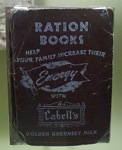
The Ration Book, an artifact from the World War II era, reminds us of a time when the idea of too much to do and too little time (not to mention resources) took on depths of meaning that only those who experienced it can truly understand. For those of you who slept through your history classes, Ration Book coupons were required throughout the second world war to buy the supplies that were scarce, from sugar to gasoline. My old-time radio station even played a vintage commercial the other day where the spokesman urged housewives to save their used grease to turn in for making rubber! Households planted Victory Gardens to reduce the load on agricultural resources. The public was provided with toll-free numbers to contact in order to learn pointers about canning. There was so little to go around, it became everyone’s job to make sure nothing was wasted.

Like a country fighting a global-wide war on multiple fronts, each of us has only so many resources with which to accomplish what we feel is required of us in this life, whether that be work goals, family responsibilities, maintaining our households, or writing a blog! The choices we make every day determine how much we have available for the next thing we have to do. If we don’t prioritize well, we may wind up using all our resources on things that really don’t matter too much in the grand scheme of things.

Making the effort to map out what we do and why we do it might just give us an insight into better resource management. We should create our own Ration Book, making sure the items on our to-do list that are really important actually get done. And shouldn’t God and His goals be at the top of our resource and to-do list?

I am thankful as I reflect on the struggles and sacrifices that were required during World War II that God alone has no Ration Book. His resources are limitless. The love and support He has to offer are without end. We can dip into the truths of His word and go to Him in prayer as often and as long as we like, and we will never run out of “coupons.” The armor of God that Paul encourages us to put on will never fail us. And, many times, God’s love provides us with resources we didn’t realize we had in order to accomplish His will.

In this finite reality, only our ability to reach toward the Infinite through the intercession of Christ makes it possible for us to expand our Ration Books so that His love may be experienced by non-believers through us.

Posted in Christian Living, Faith

He’s Everywhere

20120901-100813.jpg You can learn more about God anywhere you are, even if where you are is a tiny, but fun, zoo in a place like Abilene, TX.

At the Abilene Zoo, you can purchase specially-made crackers that you can feed to some of the animals, including the giraffes. But how do you get access to a giraffe to feed it a cracker? Luckily, the zoo has a wonderful bridge that arches over the giraffe enclosure to allow you easy access to the giraffe at his own level:

20120901-101614.jpg

So, how does a chance to feel a giraffe’s tongue on your cracker-filled, outstretched hand teach you something about God? For one, without the bridge that brings you on eye-level with the giraffes, what chance would you really have to pat the silky nose of such a tall, tall animal?

Like the bridge, Christ serves as our source to reach out to the Almighty Creator. As our Intercessor, Christ offers us the bridge to reach out to God. Even though God is so mighty, so beyond our ability to fully understand, because Christ lived as a human, died for our sins, and rose again incarnate, we get to walk with Him beyond the curtain into the innermost sanctum to worship.

Those who, through prayer or through the deep breath of clean air on a perfect day, feel the presence of God, stroke His silky nuzzle (so to speak), know the value of the Bridge that gets us there.

Who knew a trip to the zoo could be so illuminating . . . besides God, that is?

Posted in Christian Living, Faith

The Eyes That See

20120821-195839.jpgAnyone who has ever lived with an animal knows the almost creepy feeling you can get that something is boring into your back–namely the fixed eyeballs of your beloved pet as he wills you to take a look in his direction. You may not have even seen him come into the room, but suddenly you are aware of him standing there, silently requesting his dinner.

If only we could remember that God is also always there, silently watching, with eyes even more piercing than any of His creations.

But the comparison goes even further than an ever-presence. Just as a dog is totally devoted to its owner, God is wholly devoted to us, even though we are far from “owning” our Maker. No matter what His piercing eyes see, He is always ready to forgive, and nothing we do can separate us from His love.

As Paul proclaims in Romans 8:38-39, “For I am convinced that neither death nor life, neither angels nor demons, neither the present nor the future, nor any powers, neither height nor depth, nor anything else in all creation, will be able to separate us from the love of God that is in Christ Jesus our Lord” (NIV).

So, the next time you think about the omnipotent power of God, remember that the eyes that see everything are tender, gazing with a compassion we lack the ability to understand upon all of us, always.

Posted in Christian Living, Living, Self-Help

Are You Too Old To Be “Schooled?”

20120813-184144.jpg Anyone who has ever been a teacher in a formal setting knows that you learn materials best by having to teach others, but you also know that you have plenty of things you can also learn from your students, as long as you are open to the idea.

But, anyone can benefit from the possibilities that occur when we are open to learning from others, no matter if we are supposed to be teaching those others or not. And those others can be young people half our age as well as our “elders,” can be people who make almost no money to those who make millions.

Case in point: I have been doing desktop publishing for our family health food store for almost 17 years, an outcropping of experience I started gaining when I was just in high school journalism classes. Lately, I have had to hand over some of my duties to a young woman who works for us. She is about to begin her junior year in college. I am almost 20 years out from my graduate degree. Sure, so far, I’ve had to edit her work as she puts together test ads for me, but they are fairly small changes that I can easily explain to her to improve upon the next time.

What I have learned so far is that it is very nice to have a second voice offering ideas about advertising slogans and perspectives. It is quite a bit quicker to edit an ad layout that is already quite strong than to have to come up with the entire ad to begin with. I also have been reminded that other people can come up with creative and intelligent ideas.

Today, I even learned that I could use a computer program I hadn’t even thought about in a while to create cropped pictures with traced transparencies that will be very useful for my advertising and marketing and website purposes. I was so happy to be able to say to my younger employee that we could learn from each other during this process! And the employee was excited too.

My point is that in order to learn from anyone, from a superior at work to a young person you might otherwise write off as naive or inexperienced, you have to be open to the possibilities and willing to see the world through an unbiased lens. Forget the attitude and especially the fear that keeps you from admitting that you still have things to learn, especially when you are dealing one-on-one with somebody. I think you will find that people will respect you more when you are honest about what you know and don’t know instead of putting on an act of bravado and never admitting that you still have something to learn.

God wants us to be always open to instruction. The Proverbs discuss the importance of discipline. The Old Testament is replete with reminders that God will humble us if we do not take care of our attitude ourselves. In the New Testament, Jesus reminds us that we must come to Him as little children, meaning with an attitude of full faith that includes admitting we don’t understand everything but are willing to believe anyway.

None of us are ever too old to be schooled. And since we never know exactly how God is working the things that happen in our lives to the good, don’t we all have every reason to be open to learning from anything and everything that happens to us? Even a two-year-old knows a few things that we have managed to forget as adults. Have you ever seen a better nap-taker?

Posted in Uncategorized, Writing

One Small Step. . . .

Potential cover for "The Texas Stray"  Writing even a decent story takes time, especially when writing is the thing you do because you love it, the thing you do when you have finished doing all the tasks required of you for the job that pays the bills.  Even when you put the final period to a manuscript over which you may have slaved for definitely months and, more often, years, your work is far from done.  I would argue it is at that moment that the really hard work for your writing actually begins.

It is difficult to be one’s own editor, but the best of writers do just that.  Being a good editor means first giving yourself time between finished first draft and beginning revisions.  You need to be able to hold your finished work at arm’s length to view it, not still be in the stage where you are cuddling your words to your breast like a new-born child.

Once you have given your work a good three- or four-time-critical eye, it’s a good idea to have some test readers before you unleash your latest jewel on the unsuspecting public.  These test readers are ideally not your grandmother, who loves everything you do, or even your best friend.  The best test readers are people just like the ones you wrote your book for in the first place.  If you can manage it, a quick critique form to go along with your test book might offer you some very valuable information about just what your book needs to take it to that next level.

But still, your job is just beginning.  While others are perusing your work, you should be writing up the cover material for your work, the synopsis that will give the readers an idea of what your book is going to be about and that will make them want to read it.  What is the gist of your story?  What is the main thing readers will get out of reading your book?  Does your main benefit actually appeal to your target audience?

Next, you get to become a marketing expert as well as a writer.  You need to design cover art that will appeal to people flipping through ebook lists or scanning shelves at a physical bookstore.  Are the images you are using legal for you to use?  Again, does the art work convey a message that meshes with what happens between the covers?  Will it appeal to your audience?  How many possible great reads have you passed up because the cover did nothing to compel you to read more about it?

Besides the visual appeal of the cover, the actual title of your novel needs to be catching.  It is your hello to potential readers.  A dull title gets you ignored every time.  Titles are a bit easier to test than other aspects of your book.  People in your church, a survey of your friends on Facebook, even a few phone calls, can give you a pretty good idea if your title makes people interested, confused, or bored.

Of course, all this action has to proceed as you also strive to live your life.  You still have to earn a paycheck, wash the clothes, feed your family, clean your house, work on your blog and other outreach vehicles, keep up on paying your bills.  And, probably, you’re also already beginning the next, great project–for who among us doesn’t always have at least two or three ideas rumbling around in our heads that we want to finish some day?

As you might have guessed, I am finally reaching the point where I am closer to publishing my second novel, The Texas Stray.  The picture above is my second cover.  I’m not sure it will be the cover.  I still need to write up a decent sales pitch, and I am just beginning my third serious edit.  So, now is the time for me to practice patience.  I want to offer fiction that is worth reading and that gives a positive message about living a Christian life, even as it looks at the challenges every Christian faces.  Just because it is easy to self-publish these days does not mean that I should jump so quickly into publishing that I actually offer an inferior product.

So, here’s to all of us trying to grow an audience of readers who enjoy what we do, wearing all the hats in the publishing spectrum while we do so.  Thanks to all of you who support this blog by reading it each week.  I hope that your experiences are enhanced by what you find here.  I know my writing and life journey have been greatly blessed through the gift of having the opportunity to do this–on my own terms and in my own time.

God bless.

Posted in Uncategorized

How Clear Is Your Reflection?

  For now we see only a reflection as in a mirror; then we shall see face to face.  Now I know in part; then I shall know fully, even as I am fully known. 1 Corinthians 13:12

When was the last time you took a good, long look at yourself?  Better yet, when was the last time you walked by a reflection and had to do a double-take to realize that you were the person in the mirror?

Isn’t it funny how easily we can see our outward imperfections when we do take time to look in the mirror?  The lines around our eyes and mouth make us look older than we feel inside.  In our own minds, we still look like the young child who loved to skip and jump.  In our finest moments, we see ourselves as we look best.  At other times, we do a grand job of berating ourselves for every perceived flaw we can see.

But, how often when we look in the mirror do we actually concentrate on what is reflected from the inside, from our souls?  How difficult is it to see ourselves truthfully, through God’s eyes?  As Paul writes, our mirror image is only a reflection.  When we see with God’s eyes, we will see face to face.  And Paul’s writings make it clear that this kind of seeing is a life-long process of practicing faith, hope and love that will only be fully realized when we are in God’s presence.

Besides trying to see our true selves on a regular basis, especially as we come before God in prayer or request, shouldn’t we also be working on how well we reflect God to the world?  After all, aren’t we the only picture of Christ much of the world sees?  Even this reflection is not as clear as the face-to-face picture.  Being only a reflection, how much more should we strive to show God’s love at all times?

Living life face-to-face is a challenge in a race worth winning, as Paul would say.  He should know.  Do you realize, he took three years from the time of his conversion to even begin any kind of missionary work?  And that more than a decade passed with God working on Paul’s growth before He got Paul’s ministry well under way?  God can do great things, in His time.  We just have to be patient.

And keep reflecting!

Posted in Christian Living, Faith

Delightfully Sweet

20120720-170411.jpg When really bad things happen to other people, once you finish doing what you can do to help those people (which, most of the time is time spent on your knees in prayer for them), it’s then that you can take a moment to appreciate the good things that God gave you that day.

In his book, “Where is God When It Hurts,” Philip Yancey explains that one of the good things about pain is that, without it, we wouldn’t have a concept of what it really means to be healthy. This certainly applies on the physical level, but it also applies to our emotional state. Without loss, we wouldn’t understand gain. For those who have survived life-threatening illness, for example, every day when you don’t feel sick or that illness stays in remission is a good day.

Too often, we get so caught up in the day-to-day challenges of work, housework, cooking, errands, that we forget to appreciate the “normality” of that day. What a blessing dirty dishes can be! What an even bigger blessing the sight of butterflies and birds outside my window.

Bad things are going to happen in an evil world, even to those who believe in the One who gave His all for us. Believing that God “works to the good all things for those who believe in Him,” is sometimes hard to do when really bad things happen. But, isn’t that what faith is all about?