Posted in Christian Living, Faith

Finding His Strength in My Weakness: this Broken Road

My grandmother’s life of hardship offers lessons about learning to lean on God’s mercy and power.

We fickle humans do not thrive in abundance. Sitting in my fancy easy chair typing these words, I have more in my possession today than past generations of my ancestors ever hoped to possess. And yet, I daily struggle with doubts and fears, pride and anger that are incongruent with my economic “wealth.”

I have fallen victim despite the roots of my practical raising to the dream of finding happiness in a world where evil dwells. Even though I know that God’s reason for me has nothing to do with my happiness in this life, I still keep trying to find it.  Even when I embrace the idea of seeking to thrive despite the pitfalls of living in a fallen world and I strive toward becoming what God needs of me for my eternal home, I too quickly fall back into the mind traps of the transient peace that happiness offers.

I don’t think it takes a scientific analysis or Gallup poll to figure out that those who face the most challenges tend to be the most at ease with themselves and the God they worship. My grandparents didn’t have time to contemplate their mental states on a regular basis. They were too busy scratching out a living on unforgiving soil, stitching up clothing well beyond its use-by date, laboring with hands cracked by years of exposure to sun and wind, doing without when crops failed, stealing pecans from the pack rats’ nests to sell to the grocer for thread.

When a bath takes more work to make happen than the pleasure being clean subsequently brings, tell me of your repugnance to the smell of those who adhere to the once-a-week bathing regimen. When the only light you can afford is the billowing, blackening heat of a kerosene lamp, you’ll understand the wisdom of a sun-up to sun-down mentality.

Living in a world where abundance is hard to come by makes you appreciate and recognize blessings. You’ll walk miles in bad weather to catch the matinee on Saturday. You’ll eat bar-b-que you didn’t have to make off of strips of brown, butcher paper as if you were dining in an elegant restaurant with linen tablecloths instead of the planked, rough boards where strangers sit elbow to elbow, dripping sweet, savory sauce from puffy lips.

God understands the importance of our weakness to make use of His strength. He offered abundance to His people as they wandered in the desert. For forty years, He gave them sufficient food for each day, food they did not have to labor for or worry about. In this abundance, His people forgot about Him over and over again. They worshiped false gods even though the proof of the One, True God descended upon them in harvest every morning. They married outside of their own faith despite His warnings to the contrary.

We read about the wanderings in the desert with a little contempt today, but are we any different? Even the poorest among us in this country have more than most of the rest of the world and instead of thanking God for our abundance, we shun His very existence. We let others mock His power and forgiveness. We put up with those who would silence us when we want to call out His name.

When I am weak, He is strong. When I am most aware of my human frailty, I am most likely to feel gratitude to a God that saves me from even greater evils than those I face. In weakness, I will understand the satisfaction of a life lived as testimony as opposed to a life lived for my pleasure, the difference between a broken road and a road that will break you.

I asked my grandmother once about the invention of such time-saving household tools as the vacuum cleaner. My textbook said women loved these things because it gave them more leisure time, after all.

Grandmother had lived in houses whose floors were hard-packed dirt. She had worn clothes made from flour sacking and been the cook and cleaner and clothes washer and butter churner and quilter and more in her childhood family of three brothers and her dad since her mother passed away when my grandma was a toddler. She had cooked over campfires and seined coal from the river, walked miles to the mill where gathered grain could be ground for flour and plucked chickens she had slaughtered for the evening supper table. She worked seven days a week from the time the sun rose to the time the sun set in a world where all the people around her were eking out the same kind of existence.

These were the greatest generation, those who fought for the freedoms of people a world away, sacrificing life, limb, and the little things at home to make sure the world was a safer place. People planted gardens, learned to like margarine, rationed everything, saved even the dirty grease from the stove to donate to the factories for the cause of making rubber. The Depression had taught them how to make an onion and some parsnips last to a week’s worth of suppers, inspired the pickled mesquite bark in their cupboards and the repurposing of everything so that years later, my grandfather saw nothing wrong with using the same pan for his famous popcorn as the family also utilized for upchucks.

So, did Grandma think the vacuum cleaner was a gift sent from God? Definitely not. This abundance just meant she had more work to do. Standards of cleanliness rose along with our ability to clean until she was left with even more work than she had experienced before.

God’s enough is defined by our weakness turned toward His strength, which manifests itself in our love for Him and His Word, and the resulting love we then have for ourselves and others. If I can concentrate on being thankful instead of on the electronics I have surrounding me or the pretty clothes or the nice car, perhaps I will finally find that core of strength that is woven in my DNA from those who lived when abundance was only found in weakness. I appreciate the lessons they taught me by merely surviving amidst untold hardship and tragedy. I appreciate even more that they survived in full knowing of the gratitude they owed the Divine for every victory He allowed them, even in the midst of sandstorms and rain, of brown, crispy harvests and loved ones laid much too soon into the hard, cold ground.

Despite a lifetime of hardship and loss, my grandmother never gave up on her belief in God. She treasured the large print Bible I gave her on her 90th birthday because it gave her the ability to read more of the Bible daily than her cataract-challenged eyes had otherwise afforded her.

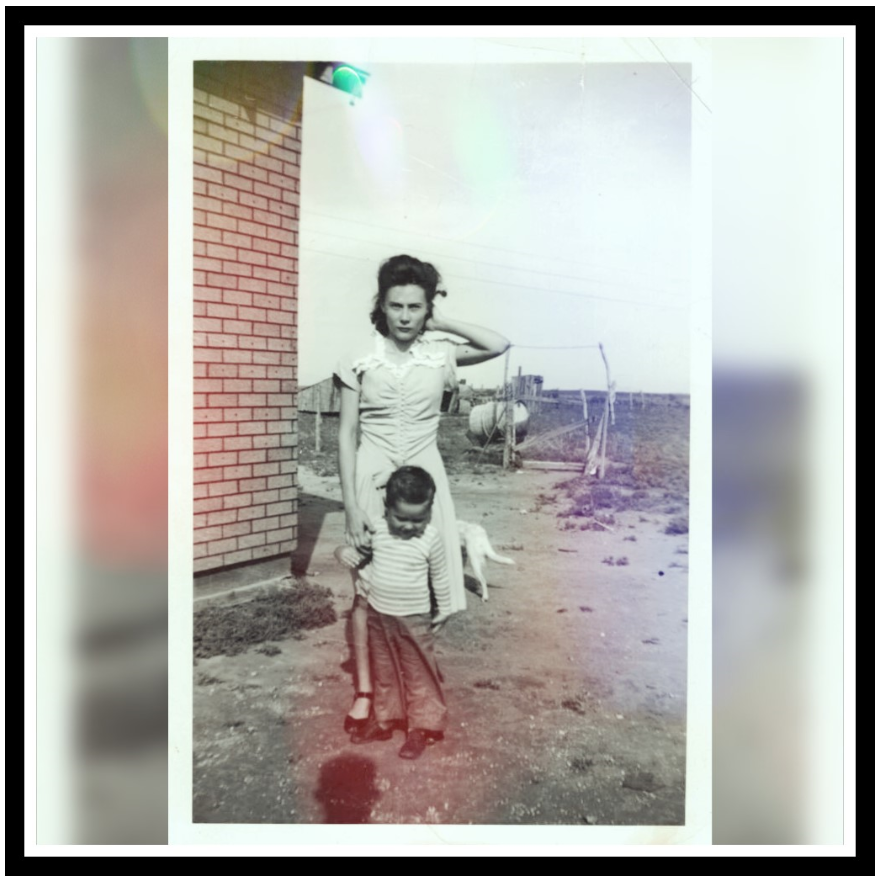
The capacity to find God’s strength in our own weakness might be summed up in a photograph I found among my grandmother’s belongings, a color snapshot of a chihuahua, my grandmother’s long-time house dog long-since passed, sitting on a plaid blanket, with these words written on the back in a steady hand:

A small brown dog with big, beautiful eyes that wanders through the halls of my memory.  Helen

If she, who had lost mother and husband and son and father and brothers, and yet never lost her faith in God, could find sweetness in the memory of loss, then what other proof of the value of accepting my weakness do I need?

I will try to recognize my abundance and its concurrent enemies of seeking happiness and fulfillment for what they are, which are obstacles to my ability to know and give the love God so freely offers to all who believe in Him, especially to those who allow Him to show His strength through the very weakness we usually fight to keep away. As I heard Rick Atchley preach just recently, we cannot ask God to make us stronger Christians and also ask Him to make everything all right. Only through the suffering that weakness brings can God truly do His work in us.

My grandparents’ generation proved the truth of this theology. More importantly, Christ sealed the truth of it when He willingly died in weakness on the Cross so that all humanity might be saved through faith by the love of the Almighty. That’s the strength I lean on. Won’t you join me?

In Christ,
Ramona

Posted in Christian Living, Faith

No Plot Twists Too Great for the Greatest Storyteller

We cannot know what God does

In the classic satire, Princess Bride, a very young Fred Savage plays a little boy listening to his grandfather tell him a fantastic story with so many twists and turns that Fred interrupts him at one point to exclaim in exasperation, “Gee, Grandpa, what are you telling me this story for?”

So often as I study my Bible, I find myself empathizing with little Fred. I am so engrossed in the action and emotions of the story that I am reading, that I often do a double-take when the narrative shoots off at a wild angle, completely different from anything I might have predicted or expected. In those moments, I find myself asking God, “Why are you telling me this?”

A case in point is the wonderful exposition of the life of King Solomon. David’s son begins with the greatest of intentions. He asks God for the wisdom to properly rule the kingdom of Israel. This wisdom is something much more than being a walking encyclopedia. Instead, the type of wisdom Solomon asks for and receives is the discernment to “read” the world from a holy perspective. It’s the kind of wisdom that allows him to know that the true mother of a child would rather see that baby given away than cut in two. It’s a wisdom that allows Solomon to amass a fortune and demand a level of respect around the world heretofore unknown in the Jewish experience.

And yet, even with all this wisdom going for him, we read that Solomon acted not so wisely as well. He married women, so many women, even those outside his Jewish religion, despite God’s express command against such unions, a command that included the warning in no uncertain terms that such unions would lead to the nation’s downfall. At one point, we are told, Solomon had some 700 wives and 300 concubines!  Especially in his old age, these women from foreign lands were easily able to lead Solomon into worship of other gods—gods the scripture defines as detestable to the Lord.

So we come to my why are you telling me this moment involving Solomon. As I read for the umpteenth time this morning the story of Solomon’s lack of judgment which ultimately led to the splitting of the kingdom of Israel and its eventual downfall, a lesson from Solomon’s folly came to me that I had not quite considered before.

My “God messages” and “Holy Spirit lessons” have been coming to me lately involving the themes of grace and becoming. I am saved because I believe in Jesus as my savior. I spend the rest of my grace-covered life becoming what God has pre-determined I need to be for that heavenly home that lasts forever and makes this earthly existence look like the blink of an eye. But, nothing I do in the process of becoming has anything to do with the promise of my salvation. The two processes are locked together and yet intricately separate. And, if I can get this truth clear in my emotional as well as logical response to people and situations, I feel that I will be so much better at loving the world around me instead of judging it.

From Solomon’s folly, I am reminded that no matter how smart I think I am, my brain is an unreliable vessel for my salvation. I cannot stay in relationship of good standing with my Creator unless I go through His son, Jesus, and that process involves my faith, not my wisdom. Despite a mind gifted with discernment known far and wide and across time, Solomon’s choice to move out of relationship with God by turning to other idols cost him dearly.

grace is God wanting to be in relationship with us, no matter what

Even with discerning wisdom, look how quickly Solomon fell into the trap of thinking he could manage his own relationship with God. What other explanation would there be for a man so wise to ignore the clear rules God had laid out for His people? Don’t marry the women who are native to the land you are entering, lest you fall into the trap of worshiping their gods, He told the wandering Israelites as they prepared to enter the Promised Land. Despite being wise, Solomon allowed the temptation of his attraction for these foreign women to over-rule the knowledge he had of God’s law.

This leaning on one’s own understanding by acting outside of the dictates of an omnipotent God is a kind of arrogance in one’s own knowledge that makes me think about the modern world in which we live, where scientists are sure they have explained the unexplainable and intellectuals flick the ashes from their cigarettes and disdain the quaint belief systems they see as naïve at best and evil conservatism at worst.

If we really want to be wise, we would concentrate our whole selves on the goal of loving God and appreciating the close relationship we have with Him because Jesus died on the Cross for us. Anything that gets in the way of that love should be cast to the side so that we do not fall victim, like Solomon, to letting the ways of this world get in the way of our much more important connection to the next.

The “twist” in Solomon’s wisdom story isn’t so much a twist, then, as it is the wisest thing we might learn from a king famous for his mind. Seek discernment on your path toward righteous living, yes, but lean on the grace of Jesus’ gift of salvation if you expect to remain in a right relationship with your Creator, especially throughout a long life full of the pitfalls that can trap a man, or woman, bent on thinking his or her way out of the scrapes that ensue when we start listening to our own hearts instead of the heart of our ever-present and oh-so-loving God.

In Christ,
Ramona


Posted in Christian Living, Faith

Live In Full Knowledge Of Your Becoming: God’s Perspective On A Life Lived Well

God is interested in my becoming, not my being

I wake to sleep and take my waking slow.

Poet Theodore Roethke sums up life in this refrain to his famous poem. A life fully lived takes the most advantage of every waking moment, squeezing out of every experience as much learning and joy, love and hope as is possible.

God longs for us to live this way, in constant communion with Him. He wants us to seek Him on our best days, our worst days and every day in-between. He promises that if we concentrate on Him, on His blessings in our life, on His dreams for us, on the kind of actions that bring Him glory, we will know a kind of peace that supersedes any challenges this troubled life may offer.

How unfortunate it is that when bad things happen, we flawed human beings tend to rationalize our way out of our relationship with God. We wonder how a good God could let such bad things happen to us, especially when we have spent our lives worshipping Him, studying His word, praying.  Some, like seed planted in thorny ground, give up on knowing God at the first sign of real hardship. Others continue reluctantly in the path of righteousness, maintaining a wary contact, wondering what is left for us in this world if even the worst of things can happen to people who believe.

But these reactions are in antithesis to how God is really acting in our lives. For God, the point of us lies not in our being but in our becoming. When I first had that said to me in a Sunday school class on Romans, I jotted it down in my notes and then promptly went on with the busy-ness of living. Then, I read a similar sentiment in the devotional, Jesus Calling, and something inside me clicked. So, let me say it again:

For God, the point of us lies not in our being, but in our becoming.

My limited perspective wants to settle into the being part of living. It wants to wallow in self-pity when things get rough, give in to pain, and sometimes just give up. But, if I faced a problem knowing that God can use each situation to help me become the kind of soul He needs for His kingdom, imagine how my concentration shifts from why me, to how might I grow.

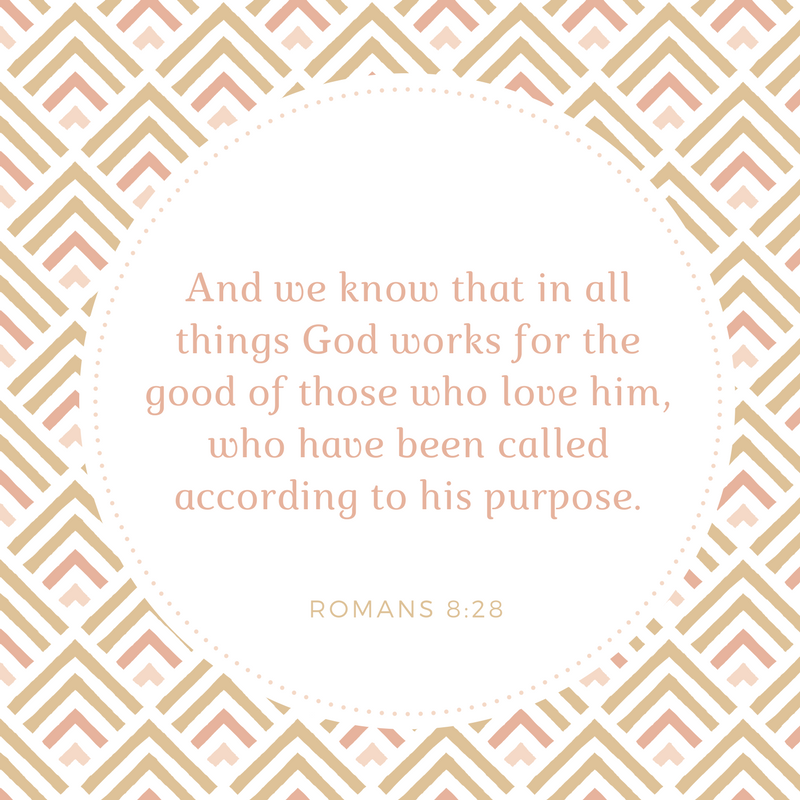
I don’t believe God causes pain. Pain is a natural part of our fallen, evil-exposed world. But, I do believe God feels my pain, and that He approaches my pain from the perspective of what the sum total of my experiences will eventually make of me. No wonder Paul assures us that “in all things God works for the good of those who love him” (Romans 8:28).

Realizing that God is always working in my life to make something of me that only He knows the full ramification of and need for puts tragedy and pain into a completely different, mind-blowing paradigm for me.

Romans 8:28--God works for the good, always

Our being, our pursuit to stay in the moment of being us is where our limited human brains stay most of the time. When we set goals, they tend to reflect our most limited human perspective: we want to exercise more, eat better, follow God’s commands by being more loving toward others or increasing our volunteer time or giving, reading the Bible more consistently. It’s not that these goals are unworthy or should be cast aside. It’s not even that these goals won’t also teach the perseverance that leads to stronger character.

Even from our limited human perspective we know that a life lived without challenges is a life that is hard-pressed to grow. God, who has His heart set on what we are becoming, is the only One who grasps the full picture. He is the One who tells the oceans they can only come so far. He is the One who underscores our limited-ness by always giving us just enough. We have exactly what we need to know about Him and our reason for becoming in His Word and through our open communication with Him through prayer.

God cares about my becoming. And I only go through becoming like experiencing the pains of childbirth. I cannot think my way into another person. I must experience joy and pain, triumph and tragedy in order to change.

No wonder His word admonishes me to seek Him with a grateful heart, casting each need in the light of the thankfulness I owe my benevolent Creator. If my mind is set on being thankful and loving, my becoming will remain in the all-important arms of the One who knew where my becoming would end even before I was born.

I wake to sleep and take my becoming through the grace of my loving God. Next time you are tempted to wonder why bad things happen to good people, wonder instead at the mystery of your becoming in the arms of a God so loving that He knows all your flaws and yet willingly died for you anyway.

In Christ,
Ramona

Posted in Christian Living, Faith

Avoid Once-In-A-While Theology

holy-word

The temperature outside dropped dramatically a few weeks ago, giving Houstonians a chance to dig in the back of our closets for those few items of winter wear that we only get to use for a few days each year.

Too bad too many of us treat our Bibles like out winter wear in a hot, humid climate. We place them on a shelf and let them gather dust for much of the time, only pulling them from their nests when we trek to church on Christmas Eve or Easter.

The problem with approaching our Bible like our winter clothing is that when we reach a day when we really need the Words that are our most direct connection to the living God, we have no idea how to find the answers that would serve us best.

What a comfort it is to know, for example, that even a man like David, who loved God with everything that was in him, who was referred to in the Holy Word as a man “after God’s own heart,” could stumble spectacularly. When we stumble and think that God won’t want to hear from us, we can turn to the example David set for us. Even knowing that he deserved to be punished for his sin of adultery, David continued to plead with the God he served, whom he knew to be loving and good, to spare the life of the son who was the result of David’s sinful union with Bathsheba.

David’s life gives us even more insight into God’s love for us. With his heart, so much like God’s, David not only doesn’t hate his son Absalom when that rebel kills his own brothers and tries to usurp the throne from David, but also mourns Absalom’s death as if Absalom were the most perfect child on earth. Only a truly, deeply-loving heart could mourn the death of this rebellious son as David does. In fact, David is so overwrought when he is told of his son’s death, that he has to be told to buck up before he makes his own triumphant soldiers, who have backed him and protected him, feel like utter failures instead of the victors they really are.

If you rarely crack open this Book that is your most visible, accessible link to an Almighty, All-Knowing God, you are vulnerable to the lies this world and the devil, who has full reign in this fallen world, love to tell you. You believe that the only thing a person has to do to get into heaven is be basically good. As long as the good things you do outweigh the bad things you sometimes participate in, then you’ll turn out all right in the end. You start measuring yourself against the wrong yardstick, which is the people around you who also claim to be mostly good as opposed to measuring yourself in view of the lessons and dictates of the Holy Word in its totality.

A person who rarely cracks the thin pages of the Word may fall victim to blasphemies that sound comforting and reasonable from a secular perspective but have no foundation in the truth of the Word. You might believe, as a friend explained to me once, that as long as someone who really loves you asks for your soul to be with Jesus, then you are saved, whether or not you actually accept Christ as Savior yourself. You might find that the concept you have of heaven and hell are more in line with Milton’s Paradise Lost or Dante’s Inferno than the heavenly throne in Revelation where the angels dance.

It is a universal truth that failing to believe in anything makes you vulnerable to the fault of falling for everything. Never has it been more important to have a knowledge base of truth that allows you to weigh that truth against the vagaries of an internet-driven world. You cannot recognize the truth according to God if you only ever study His truth every once in a great while. And the only place to find that truth is in His Holy Word.

Cold-weather theology is like assuming you could learn three chords on a guitar, play them once every four to five months and then give a concert of guitar playing that would make the audience weep. You’d be much better served treating your Bible, not like cold-snap sweaters and scarves, but like the crisp, clean underwear you never leave home without. Even a little daily attention to your Holy Bible can go a long way toward growing your relationship with the Holy Creator.

Posted in Christian Living, Faith

Be Reconciled: Learn to Listen

tabernacle_sm

Therefore, if anyone is in Christ, he is a new creature; the old things passed away; behold, new things have come.  Now, all these things are from God, who reconciled us to Himself through Christ and gave us the ministry of reconciliation, namely that God was in Christ reconciling the world to Himself, not counting their trespasses against them, and He has committed to us the word of reconciliation.    Therefore, we are ambassadors for Christ, as though God were making an appeal through us; we beg you on behalf of Christ, be reconciled to God.   –2 Corinthians 5:17-20 (NASB)

As you probably already know, the traditional tabernacle where the Jewish people worshipped God had an area known as the “Holy of Holies.”  Before the sacrifice made by Christ, this room was as close as any person could get to God.  Only the highest priests were allowed to enter, and before they could walk through the curtain that separated this place from the rest of the temple, they had to purify themselves.  This curtain is the same that tore in two at the moment that Christ died on the cross.

The torn curtain is a symbol of what Christ’s death and resurrection did for us.  It reconciled us to God, giving us direct access to the Holy of Holies through our acceptance of Christ Himself as the sacrificed Lamb who died for our sins once and for all.  Being thus reconciled to God, Paul explains in his second letter to the Corinthians that we are now a new creation, people who, being filled with the Holy Spirit, now long for that which is right and good rather than the desires and temptations of the flesh.

This new way of being is a daily choice, for the world in which we live is full of distractions.  Instead of allowing the Spirit in us to guide us, our brains are literally hard-wired to feel first and think later.

Feelings are inherently immature. God warns us not to lean on the guiding of the heart, “the great deceiver.” Acting on feelings is what leads David to sin against God with Bathsheba. Feelings make the Israelites call to Aaron for a golden God when Moses disappears up the mountain.

If you will let Him, the Holy Spirit will save you from those emotional responses that need to be tempered by a logical, God-fearing mind. The Holy Spirit fills you with empathy instead of rage when that car pulls right in front of you on the freeway or when you become the victim of somebody else’s bad day.  It guides you to choose the right path even when the wrong path looks ever-more inviting.

The Holy Spirit, the marking of a soul reconciled to its God, is what makes it possible for a feeling-driven human to become a true ambassador of Christ, a person who, through his or her actions, makes others understand that God really does love each and every one of us, wanting all to be saved.

Discerning the guiding of the Holy Spirit as opposed to our feelings is not easy. There is a reason that Jesus tells us the way is narrow instead of wide. If you need to know if what you are thinking is in line with God’s teaching, you have to know something about what those lessons are. You will discover this best by studying the Word, discussing His Word with others and staying in communication with God by speaking to Him often and also learning to be still and listen for His answers.

If you have never been reconciled to God, know that reconciliation is a gift, bought for you at the ultimate price, paid for by the blood of the totally innocent Christ. All you have to do to claim this gift is have faith, to believe that Christ died for you and accept Him as your Savior.

Do not live your life as if the curtain separating you from the mighty God still hangs between you and that love. Live the truth of the torn curtain by welcoming the Holy Spirit into your daily walk with Christ. Know His word, and you will recognize the voice of the Holy Spirit as surely as you hear your mother’s voice telling you those life lessons you know but are letting your feelings override. The Holy Spirit is the voice telling you:

Finally, brethren, whatever is true, whatever is honorable, whatever is right, whatever is pure, whatever is lovely, whatever is of good repute, if there is any excellence and if anything worthy of praise, dwell on these things. (Philippians 4:8)

Dwell on the glorious truth that you are reconciled to God and discover how much easier it is to be forgiving towards others and yourself.

Posted in Christian Living

Learning to Pray

Hagar by Edmonia Lewis

Next to our very precious salvation, prayer is the greatest gift we have from our loving Father. In prayer, we clumsy, defective humans get to communicate with the One who is so powerful, even our amazing brains don’t come anywhere close to comprehending His magnificence.

Besides the book of Psalms, which might be called a book of prayers, there are also many prayers throughout the Old and New Testament. Moses prays for Israel in the Wilderness. Solomon prays for the newly finished Temple. Mary prays for the gift of the Son of Man. In times of great trouble or tremendous joy, believers lift their voices to supplicate and praise an awesome God.

Before Christ tore away the curtain, the only people who had direct access to God were the High Priests, who went into the most Holy of Holies to be in communion with the most direct connection to God humans at that point had. But, when Christ died on the cross for our sins, we were given an intercessor who gives us direct access to God any time we take advantage of it. The Holy Spirit, who dwells in those who believe that Christ is the Savior, is who makes it possible for us to know that when we call out to God, He is always listening.

God promises to answer every prayer. Because His answer can be no, we often forget that God doesn’t break His promises. Have you experienced times in your life that, in retrospect, were important growth opportunities because God said no? Our limited perspective is incapable of seeing things from God’s big picture view. But learning to embrace faith in God’s ability to guide things to the good makes praying an act of truly trusting God’s will.

Jesus gave us all a pattern for praying, the Lord’s Prayer. Whether we say it word for word or use it as a pattern for our communication with God, this prayer is the starting point for any believer’s path to better conversations with the LORD.

Our Father, who art in heaven, the prayer begins, hallowed be thy name. Begin any prayer by coming to God in full knowledge of his holiness. God is the master of the universe and your life. When you approach Him in the humility fostered by this view of His awesomeness, you will be offering your most truthful, sincere self to the One who already knows what you are going to say and yet wants to hear it from you anyway.

Thy kingdom come, thy will be done on earth as it is in heaven, is the next section of this prayer. We can only ever expect God to answer our prayers when those prayers are in alignment with His will. If you pray for a nicer car or other material luxuries, you are much less likely to be in the will of God as when you are praying for your relationship with Him or the welfare of yourself and others.

Give us this day our daily bread, the prayer continues. We have the right to ask of God the things we need to make it through each day. Because God takes care of us from day to day, we are encouraged not to let tomorrow, which might never happen anyway, or the past, which is done and unchangeable, not misdirect our focus from the present moment. The present, this day, is the only thing we really have, and Jesus encourages us to trust Him to take care of our needs each day.

Forgive us our sins as we forgive those who trespass against us, comes next. The core value of prayer is the relationship we have with our God. Because sin separates us from God, only when we recognize our own foibles and bring them to God in our repentance do we come back into relationship with Him through the grace of Christ. Equally important, this section of the prayer reminds us, is our ability to forgive others just as Christ has forgiven us. If we can’t pay mercy forward, Christ tells us, then why should God be expected to overlook the sins we all carry?

Many manuscripts end the Lord’s Prayer with this plea: And lead us not into temptation, but deliver us from the evil one. The narrow path of walking a Christ-centered life in a fallen world means we will be exposed to evil. A prayer that acknowledges that we live in a world where the devil is very active helps us to understand how very important our ongoing relationship with God is to our survival. We can only stand against what we recognize as a threat.

Holiness, thankfulness, neediness, forgiveness, cleanliness–these conditions of our relationship with God are what should guide our conversations with Him. Ever wonder how we can call prayer a conversation when only we humans are talking? We can find God’s side of the conversation in His Word, where many of the answers to life’s questions can be discovered if only we will read and study the Bible in a Holy Spirit-guided way.

Your prayers don’t have to be award-winning poetry. Paul tells us they can even be groanings that are not words but still convey our needs to the Father. What prayers need to be are our honest, humble attempts to enter into a relationship with our most powerful, loving God.

Say what you feel to the LORD-ALL-POWERFUL. Anytime, anyplace, anywhere–He’s listening.

Posted in Christian Living, Faith

Whose Job Is It Anyway?

IMG_6965

Whether you run a major conglomerate or sell computers at a box store, you have a job description that more or less clarifies the duties, responsibilities and parameters that make your job unique. Accomplishing your tasks at work gives you a sense of success and even fulfillment.

But true fulfillment encompasses all aspects of one’s life. When we are at peace with God, our family, our work and our place in relationship to all these things, we might truly claim that elusive state of being known as fulfillment.

Chances are that people who feel unfulfilled are trying to do God’s job for Him. Does that seem shocking to you? As a perfectionist who is always worrying about whether I am doing what God wants me to do, even though I know I cannot earn my way into heaven, I live in the not-so-friendly world of trying to do God’s job. The consequences are that I am often anxious, frustrated, or hopeless. By questioning my life’s purpose in this way, I am denying God the job He promises to do of having my back.

“A person’s steps are directed by the LORD,” the wise man of Proverbs tells us. “How then can anyone understand their own way?” (Proverbs 20:24)

God’s word is replete with His admonition that we trust in Him. Jesus tells us not to worry because we cannot add one hair to our head. If God takes care of the birds and the meadows, He reminds us, how much more will He take care of us?  The prophet Jeremiah is assured that God knew Him before the womb, sanctifying Jeremiah as a prophet before he took his first breath.

Whenever people try to take over God’s job in the Bible, trouble follows.  When Ahab, the king of Israel, wants to go to war against Ramoth Gilead with the help of King Jehoshaphat of Judah, the two proceed against the advice of God’s prophet and attack the enemy even though God has said they will lose. By doing God’s job, the two kings fail, with Ahab actually losing his life (1 Kings 22).

How does a life look when we step aside to let God do his job? The Psalmist tells us that “the steps of a good man are ordered by the LORD; and he delights in his way (37:23).” And why wouldn’t the good man be delighted? When we wake each day knowing we are going to strive to follow God’s laws and be open to the work He puts in our path, how can we be anything but assured in our way?  If God can place the stars in the sky, surely He can guide the steps of an earnest believer like me.

Embracing God’s sovereignty in all things puts His job description into sharp perspective. God judges, so my job is not to be critical of people around me. God punishes, so my job is to forgive. God saves, so my job is to love.  Solomon writes,

“The mind of man plans his way. But the LORD directs his steps” (Proverbs 16:9)

Even though I still have decisions to make each day, knowing that the really important ones have already been made by God is very freeing. I need to lean into the realization that I am where God wants me to be. If I keep doing my job of believing, praying, and studying and acting on His Word, God will work everything in my life to the good (Romans 8:28). Success isn’t the amount of money in my bank account or the number of people who know my name, but living by faith:

I know, O LORD, that a man’s way is not in himself, nor is it in a man who walks to direct his steps. (Jeremiah 10:23)

Using faith as the answer to why can take the angst out of a perfectionist’s world. Letting God do His job will truly make all the difference in mine.

Posted in Christian Living

The Power of Gratitude

IMG_0871

As flood waters rose around Houston earlier this week, neighbors came together to help neighbors because that’s what Texans do.

In one such scene, a man holding his infant road out from his flooded house on a fisherman’s johnboat. As he stepped out of the boat into safety, he reached into his pocket to offer his rescuer the cash he had in it. Even though this man was facing devastating loss, he was so grateful to be saved that he offered all that he had in thankfulness.

God longs to hear that kind of gratitude from us, we children born in sin yet saved by the sacrifice of his one and only Son:

He has shown you, O mortal, what is good. And what does the LORD require of you? To act justly and to love mercy and to walk humbly with your God. (Micah 6:8)

A humble heart understands what it owes to the forgiver of all sins, to the One who asked of Job, “Where were you when I laid the earth’s foundation? . . . Who marked off its dimensions? . . . Who laid its cornerstone–while the morning stars sang together and all the angels shouted for joy?” (Job 38: 4-7).

In a world where even the stones will cry out if we will not praise our God, surely His praises should be ever on our lips.

 Yet, how often do we fall short of the kind of gratitude God deserves? Each day, we wake up with every intention to be good, and each day we inevitably fall short of our goal. No matter how hard we try, we can never earn our way into heaven. Yet, even though we don’t deserve to be there, God willingly gave of Himself so that we would have a free pass into His heavenly realm.
It seems like the very least we could do would be to remember to say a sincere thank You every once in a while. The New Testament writers will us to do even more than this:

Give thanks in all circumstances; for this is the will of God in Christ Jesus for you. (1 Thessalonians 5:18)

Do not be anxious about anything, but in everything by prayer and supplication with thanksgiving let your requests be made known to God. (Philippians 4:6)

When we praise God, we not only please Him, but we also give ourselves a helping of the peace He promises when we agree to join Him in His “easy yoke and light burden” (Matt. 11:30).

In her great devotional, Jesus Calling, Sarah Young encourages us to thank God in all things in order to draw ourselves closer to Him. For example, she writes, we should be thanking Him in advance for His answers to our prayers.

Perhaps you do this all the time already. Perhaps, like me, you have been so intent on the need in your praying, you have forgotten about God’s promise to answer all prayers. His answer may be no, but He always gives you one. When I followed Young’s advice and added thankfulness to my requests, I was quick to discover the calming ability of a little bit of gratitude.

What happens when we don’t give God thanks? Paul tells us this lack of attention leads only to despair:

For although they knew God, they did not honor him as God or give thanks to him, but they became futile in their thinking, and their foolish hearts were darkened. (Romans 1:21)

Practice thankfulness on the easy days, and you'll be ready to be thankful even on your darkest days.
Practice thankfulness on the easy days, and you’ll be ready to be thankful even on your darkest days.

On a sunny day, laying in the shade of your favorite tree and sipping lemonade as you listen to the birds chatter over your head–that’s the time to start working your gratitude muscles. Discover new and loving ways to say thank you to the Maker of Heaven and Earth.

It’s those sunny-day thanks that will give you the reflexes to find gratitude as you wallow in life’s shadows. He is sometimes harder to find in the valleys, until you topple into His open arms and realize just how much you actually depend on Him. When you finish being angry at Him for the mess you’re in, you remember the joy of times spent in His presence when being thankful was easy.

You realize just how many reasons you have to be thankful for Him in the midst of your greatest trials.

Like the psalmists who found words of praise for the Lord on a daily basis, you too should vow to:

. . . give thanks to the Lord because of his righteousness./ I will sing the praises of the name of the Lord Most High. (Psalm 7:17)

Make gratitude a major component in your relationship with God and others, and you’ll soon discover how powerful the words thank you can be.

Posted in Christian Living

Denial Ain’t Just A River In Egypt, Unfortunately

Nile_006
                            The Nile River

Our country was founded on the principle of being “one nation under God.” For some, the experiment of government which began in 1776 represented the supreme achievement of humanity, a project that surely had the approval and even power of God behind it.

I wonder what those founders would say about the country we have today. Do we still reflect a nation under God?

As I watched an episode of “Family Feud” recently, I was struck by the number one answer to the prompt that cuts to the heart of this question of our nation’s “godliness.” When asked how many of the Ten Commandments they had broken in the past week, the majority of people said once.

One time, really? As comedian John Pinette might put it, “I say, nay, nay.”

What this response revealed to me was the depth of our self-delusion in a world marked by a strong reliance on a belief system that is really humanism cloaked in religion. Humanism places mankind above all things, going so far as to make man a god. The end goal of humanism is happiness, often achieved by convincing the self that it is the best possible self it can be.

Humanists have a relative moral compass. As long as they don’t hurt somebody else, then they are living good lives. In fact, if their ultimate happiness is achieved by their actions, then even if they hurt somebody, their actions are justified.

Television, movies, the internet, and the unyielding consumerism machine all support the humanistic approach to life. They are pervasive, persuasive and corrosive. They do a great job of lulling us into a sense of security so that we don’t even realize when the lines between religion and humanism are blurred.

Consumerism leads us away from God.

But when we get specific, the walls of humanism crumble. Consider the Ten Commandments question. Because we are conditioned to see the best side of ourselves, we really don’t see our own failings. We fall victim to the pride that most severely separates us from the one, true God.

On any given day, we must fight the temptations that would have us breaking the commandments. How often do you allow the cares of this world to get in the way of your relationship with God, whether it be watching television when you could be studying the Bible or trying to juggle your funds because of purchases you should not have made? Are you ruled more by God or by the bills in your mailbox?

Do you really make it through a day without wanting the handbag some woman is carrying in the mall or, even more likely, the kind of life you see blaring from your television screen? You may not follow through on the desire, but you are still coveting.

Were you short with your father or mother this past week? Did they make a simple request you scoffed? Can you not remember the last time you even spoke to them? Honoring your father and mother involves more than just doing what you are told when you are under their roof.

Did you know that God hates a loose, lying tongue? Look for verses on the words we speak, and you will find countless references in the Word warning us to bide our tongues. In Revelation, God equates perpetual liars with those who practice sexual perversions on the sin list. Did you tell the whole truth in the last week? Were your words kind, uplifting and of the Spirit? Did you manage to refrain from gossip, which is usually a half-truth that is still a form of lying?

Do you think my take on the commandments is too strict, too overreaching? Read the Sermon on the Mount. Christ did not come to the world to negate the Law, but to fulfill it. His sacrifice saves us from our own sinfulness, but it does not give us carte blanche to sin. In fact, Christ’s approach to living takes the Ten Commandments to the next level.

In the Sermon on the Mount, Christ implores us to not only not commit adultery, but to not even think about it. If one part of our body leads us into sin, He tells us, then we would be better served to rid ourselves of the offending body part then risk not making it to heaven.

Choose to be humble.
                     Choose to be humble.

God loves humility, which the Bible defines as the “fear of the Lord” (Proverbs 22:4a). A humble heart embraces its own failings. A humble heart sees truth through the eyes of its Maker and not according to its own desires. “Pride brings a person low,” the Proverbs tell us, “but the lowly in spirit gain honor” (29:23).  As opposed to humanism, which encourages people to consider the self as godly, Christianity implores us to “do nothing out of selfish ambition or vain conceit; rather, in humility value others above yourselves” (Philippians 2:3).

A truly humble heart would answer the Ten Commandments question quite differently. It would know that in a world that is cloaked in the grace of Christ, we still stumble. We continue to strive because of Christ’s example of love, even as we know that we will ultimately fall short. The very definition of grace, the gift of salvation from a loving God that cannot be earned but must be accepted, proves that no person is without sin.

My prayer is that we all can live in the eye-opening state of humbleness rather than the veiled existence of humanism. Only by putting God first in all things instead of ourselves will we truly see ourselves most clearly. Then, we will know that the Ten Commandments are about our everyday lives and not some archaic law to be considered once a week. Then, we will truly understand what it means to live “under God.”


Posted in Christian Living

On This Rock

PhotoFunia-river

When I was young, my Sunday school teacher explained that the Bible was such a great book, in part because it was too complicated for the most intelligent person to completely figure out and yet the simplest mind could understand its core messages.

By spending regular time in the Word, you discover that what you read can often be applied to whatever you are currently experiencing. Make Bible reading a part of your regular routine. For example, I read my Bible every day as I walk on my treadmill.

During the last week, my reading gave me several verses to help me cope with stress. They reminded me of God’s power and His intent to take care of me, no matter what bad happens to me in this world of evil.

When the psalmist says, “Make me hear sounds of joy and gladness; let the bones you crushed be happy again” (Psalm 51:8), I find someone who feels like I sometimes feel–beat down by the world’s cares but wanting to feel weightless again.

This feeling of reaching for the light is further emphasized in Psalm 51: “Give me back the joy of your salvation. Keep me strong by giving me a willing spirit (12).” I am reminded that I am supposed to have joy in this world because of my salvation through Christ, but that I need to have a can-do attitude that is willing to reach for peace when I feel most tumultuous.  If I choose to find joy in my salvation, God will help me rise above the challenges of day-to-day living.

Hannah Praying for a Baby

Do you remember the story of Samuel? His mother, Hannah, was barren, ridiculed by her husband’s first wife because Hannah could not have children. In a culture where children were the measuring stick of success, Hannah was an abysmal failure. In the psalmist’s terms, her bones had indeed been crushed.

Hannah could have wallowed in despair. Instead, she poured her sorrow out before the One who could help her. She promised God to dedicate her child to His service if she ever had one. Shortly after Hannah’s heartfelt plea, God indeed blessed her with a son, Samuel, who later became a renowned leader of the Jewish people.

In thankfulness for her blessing, Hannah sings a song of praise, in which she says:

There is no one holy like the LORD. There is no God but you; there is no Rock like our God. (1 Samuel 2:2)

God had indeed served as Hannah’s rock. Her faith in Him helped her survive years of being barren and blessed her finally with children.

As a person with anxiety, I too must strive to make God my Rock, especially on my bad anxiety days.

How does God as your Rock look? To me, He is the boulder held fast in the midst of a raging river. The mist of roiling water might soak me eventually, but I will not drown. No matter how high the water rises, my Rock will always rise above it.

And rising higher still than the rapid water is the clear, blue sky that stands for the joy of my salvation, for the ultimate gift of a loving God that makes this life livable.

If you don’t already, make Bible reading one of your daily habits. Build upon the Rock of your salvation with the Word of God. You will always find something of use in your daily life there.