Posted in Christian Living, Faith

Living in the Perpetual NOW

20140202-190447.jpg

One of the first concepts you have to “get” when you are a beginning cultural anthropology student is the idea of how many non-Western cultures view time.

For most of us, time is a linear thing, lines of days in a week or month that we can cross off or circle as we wait in anticipation for their arrival. We divide our days into morning, afternoon, and evening. We distinguish between past, present and future.

For some of us, the past is a living thing we carry each day, a burden of mistakes or victimizations we haven’t forgiven ourselves or others for. Each present moment gets lost in the miasma of not letting go of what has been. Instead of learning from the past and moving on, we stay in a cycle of non-growth.

For others, the future is our challenge. We are so busy worrying about what might happen, we don’t enjoy the moment in hand. We also fail to remember all the times in the past when our worries were proven unfounded.

In Native American cultures, the concept of linear time is quite foreign. Instead, the circular is the more favored concept. Circles represent how connected people are to each other and to the natural world around them.

The perpetual now embraces the circle in that past, present and future are considered to be always with us in each moment. We are never without what has come before, but we are also not without the promise of what is to be.

Living in the perpetual now means understanding the kind of wholeness in time that makes enjoying each moment truly possible. My best present is in full knowledge of where I have come from and where I intend to go.

For the Christian, embracing a perpetual now attitude means tapping into the awesome power that is Christ’s love for us. It is living in each moment knowing that we are forgiven. It is living like we truly believe the promise of our salvation.

In her book, Battlefield of the Mind, Joyce Meyers explains:

Think and speak about your future in a positive way, according to what God has placed on your heart, and not according to what you have seen in the past or are seeing even now in the present.

Reading and knowing God’s Word, spending regular time in quiet contemplation with Him, and believing God “will work to the good all things for those who believe in Him”–these are ways to grasp the kind of now that is backed by the full power of God (Romans 8:28).

Posted in Christian Living, Faith

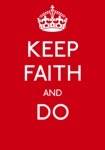
With God, there is no try

20140125-185001.jpg

Do or do not, the wise, grizzly Yoda advised his enthusiastic pupil, Luke Skywalker, there is no try.

When you are nine years old, straining forward in a blackened movie theatre, the buttery popcorn in your lap all but forgotten as you are transported once more to far away galaxies where the lines between right and wrong, good and evil, are clearly defined, you are ready to take on the challenge with your hero Luke. And you share in Master Yoda’s frustration when Luke lets the distractions of his friends keep him from moving forward in his training for the privilege of being a Jedi.

When you are decades older than that nine-year-old movie fan, you take a few moments to reflect on the wisdom of what Yoda has to say in his funny, inside-out kind of dialect. If we approach anything with an attitude that we will try, we have already admitted to ourselves the possibility of failure. Either we must proceed with the sincere belief that we will succeed in what we are doing, or we have already failed.

“All you need to say is simply ‘Yes’ or ‘No’; anything beyond this comes from the evil one,” Christ tells us (Matthew 5:37).

Yes or No. Do or do not. If we are living the life that Christ calls us to live, than when we say we will do something, it should be a certainty that that thing will be done.

Above all, my brothers and sisters, James admonishes, do not swear–not by heaven or by earth or by anything else. All you need to say is a simple “Yes” or “No.” Otherwise you will be condemned. 5:12

Perhaps, it is a bit of a hard line to say that with God, there is no try. There are certainly times in every person’s life when we feel so broken, that even being able to say, “I will try,” seems too much effort. But isn’t the precise point of faith in an Almighty God that we should take that bold step in full belief that by leaning on God we can do whatever He wills?

Christ, ever leading by example, gives us full proof of this process as He prays in the Garden on the night of His betrayal:

“Father, if you are willing, take this cup from me; yet not my will, but yours be done,” He says (Luke 22:42).

To reach success in anything, one must be disciplined to practice the skills required, over and over, in order to improve one’s abilities. Whether those skills involve scales on a piano or speaking with patience, humility and love, the discipline means moving forward with an attitude of doing rather than trying.

I cannot fail God because He already knows all the mistakes I am going to make in this life. I cannot earn God’s love because I already have it through my acceptance of Christ’s grace. But, when I accept the grace Christ offers, I am saying I will go beyond trying to follow the word of God.

I am promising to DO. Doing not?–not an option.

Posted in Christian Living, Christianity

Living, happily, in doubt

Benefit of the doubt

As I have mentioned on a few occasions, I’ve been reading Randy Harris’ Living Jesus, a guide to the Sermon on the Mount, which is practical, insightful and challenging.  Of course, I have just described the Sermon on the Mount itself, but Harris’ commentary places Jesus’ timeless words into modern terms that graciously calls each of us to the hard truths of Christ’s most famous lesson.

One of the principles that Harris puts into modern focus is discussing the Golden Rule in terms he dubs the “benefit of the doubt principle.”  In almost any given situation, you can see what is happening or what has been said by assuming the best about someone or the worst.

Most of the time, we go around assuming the worst possible scenario.  It’s the beam in our eye that Jesus was warning us about.  The clerk at the store who is curt to us is a rude person who needs to learn customer service skills. We don’t consider instead the possibility that the clerk may have distractions like a sick child at home or bills he is having trouble paying that are making it hard for him to concentrate on the task at hand.

If we respond to the clerk without the benefit of the doubt, we are probably just as curt back, not smiling, and may even complain to the manager. But, if we give the clerk the benefit of the doubt, we might smile ourselves, give the clerk a compliment, or admit that it seems like the clerk is having a rough day as we empathize with the feeling.

Try this the next time you encounter a “difficult” person, and note the amazing turnaround that is possible.

But, the change in attitude that comes with treating people with the benefit of the doubt isn’t just for the people to which you offer it. This principle affects you perhaps most of all. You might, in fact, call this the happy principle, because when you start giving people the benefit of the doubt, it is almost impossible to stay in a negative state of mind.

Thoughts such as he hates me or she thinks I’m stupid or no one appreciates what I do, etc. all fall under a different lens when the benefit of the doubt is applied.  Instead of jumping to the worst possible conclusion, if we consider the problems others might be facing as well, if we realize that the world doesn’t revolve around us, then we are more likely to be happier people.

Sometimes, a different perspective can come as easily as deciding to assume that another person’s “bad” attitude has nothing to do with you, isn’t actually directed at you, and shouldn’t be taken personally.  What if you respond to a “bad” attitude with concern for the other person or just with a friendly response that refuses to be “baited?”

Living according to the moral system Christ calls us to live in the Sermon on the Mount really requires us to stay in touch with the workings of the Holy Spirit in us.  That Holy Spirit guidance gives us the ability to offer the benefit of the doubt to others, to see past the beam in our own eye before we even notice the speck in somebody else’s.  And when we put our ego aside enough to actually do that, we’ll find that we’re happier, calmer people.

When we walk according to the benefit of the doubt, we’ll find that we feel the love of Christ in us and toward others more often.  Just as Jesus was able to point out how no one had the right to judge the condemned woman but was still able to call her to “go and sin no more,” when we lead with love, staying on the narrow path is an easier pill for everyone to swallow (see John 8).

But this benefit of the doubt principle is easier said than done, for the ego is a strong thing, constantly pulling us from the guidance of God.  Part of us wants to feel hurt, put upon, wounded.  And that part wants somebody else to blame.  If we have to embrace the concept that it is our choice how we react to the information that bombards us daily, we have to master putting God’s way first and our ego second.  Mastering the ego is mastering the concept of the benefit of the doubt.

Of course, there are times when the benefit of the doubt might not be possible.  If someone is heading toward you with a drawn knife, you’d best take evasive action.  But, most of the time, choosing to see others in the best possible light is exactly what we have the opportunity and obligation to do if we are really trying to walk with Christ:

“Why do you look at the speck of sawdust in your brother’s eye and pay no attention to the plank in your own eye?  How can you say to your brother, ‘Let me take the speck out of your eye,’ when all the time there is a plank in your own eye?  You hypocrite, first take the plank out of your own eye, and then you will see clearly to remove the speck from your brother’s eye.”   (Matthew 7:3-5)

We are so quick to give ourselves a break.  No one can be more creative than we are when we start making excuses for our own failings.  We don’t want to be too hard on ourselves, after all.  So, next time you are tempted to be harder on somebody else than you would be on yourself, get creative.  Give the other person a blessing to you both–the benefit of the doubt that leads to peaceful, and happy, living.


Posted in Christian Living, Living, Uncategorized

The Only Thing You Really Have

20140104-124610.jpg

Running an errand yesterday, I hustled through the grocery store, right past an employee carefully putting out the displays for, you guessed it, Valentine’s Day!

OK, I was in a hurry. I was in a rush to get back to work, which was piled up since I had taken a week during Christmas to go visit my family. So, my point is that I wasn’t exactly taking the time to stop and smell the roses, as they say (and pardon the pun), which probably means I have no right to complain, but since that hasn’t stopped me before…..

Come on! Those were the words that went through my head, followed quickly by, you’ve got to be kidding me? In other words, can’t I just have January to take a breather from the next thing I’m supposed to be prepared for?

And my next thought after that little tirade was that, in reality, all I ever really have is the moment I am currently in, and yet I spend so much time worrying about or preparing for something that is going to happen or may happen tomorrow or the day after that, I fail to soak in all the blessings and glory, sights and scents, all the nuances of the now that are what make a day worth living.

The Bible is very clear on this moment-by-moment approach to living:

Therefore do not worry about tomorrow, for tomorrow will worry about itself,Jesus said. Each day has enough trouble of its own. Matthew 6:34

The Preacher writes, “This is what I have observed to be good: that it is appropriate for a person to eat, to drink and to find satisfaction in their toilsome labor under the sun during the few days of life God has given them—for this is their lot. Moreover, when God gives someone wealth and possessions, and the ability to enjoy them, to accept their lot and be happy in their toil—this is a gift of God. They seldom reflect on the days of their life, because God keeps them occupied with gladness of heart” (Ecclesiastes 5:18-20). The Message puts these same verses this way:

After looking at the way things are on this earth, here’s what I’ve decided is the best way to live: Take care of yourself, have a good time, and make the most of whatever job you have for as long as God gives you life. And that’s about it. That’s the human lot. Yes, we should make the most of what God gives, both the bounty and the capacity to enjoy it, accepting what’s given and delighting in the work. It’s God’s gift! God deals out joy in the present, the now. It’s useless to brood over how long we might live.

Be sure you don’t mistake living in the now for a “live and let live” philosophy. “Be very careful, then, how you live,” Ephesians tells us, “not as unwise but as wise, making the most of every opportunity. . .” (5:15-16). And those opportunities are not to embrace the treasures of the earth but the treasures in heaven: “Let your speech always be gracious, seasoned with salt, so that you may know how you ought to answer each person,” Colossians 4 admonishes. And Christ made clear that loving God first and treating your neighbor as you yourself would want to be treated sums up the whole of all God’s commands.

When it comes right down to it, the past has already come and gone, with only the ability to repent of what wrong was done in it and move forward earnestly trying to do better. Tomorrow only comes by the grace of the One who made us all. But today, TODAY, is the gift of the moment that we have the opportunity to make the most of with all surety.

So, sorry Valentine’s Day, but I’m going to keep myself busy with today this January. As the Psalmist proclaimed:

This is the day that the LORD has made; let us rejoice and be glad in it. (Psalm 118:24 ESV)

Posted in Christian Living

The Necessity of Light

20131228-224438.jpg

In the next week or so, the twinkling lights that have dazzled our ever earlier night sky, the darkness of the deepest time of winter, will slowly fade as people pack up the Christmas decorations and begin preparing for the challenges of a New Year.

But, the need for shining of light is actually just as important on the longest summer day as it is during the month of December.

Notice how brilliant the Eiffel Tower appears in this night-time photo captured by my mother-in-law during her first trip to Europe recently. Even with just her iPhone and the basic knowledge of point-and-click, she managed to capture quite a few photos that reveal the true beauty of several national landmarks and treasures.

Even her pictures of the tower during the day, however, are nothing compared to the beauty of the shots taken at night, when the height and breadth of this amazing structure are outlined against the blackness like a thousand brilliant stars.

For a world living in darkness, Jesus calls us to be such a light. Our words and actions should be such that we display the glory of the gift of God’s love for us to all. We are the window to the soul of God, not just on Sunday mornings or during Christmas, but every day and in every way throughout the year.

As you search yourself for resolutions in the coming days for January 1, remember to put shining the light of Jesus at the top of your list. It may be as simple as asking one person to come with you to church one Sunday, taking food to a neighbor whose family member is in the hospital, or holding the door for somebody as you enter a building. If you are practicing the discipline of love, the Holy Spirit in you will be sure to guide you.

Shine His light in 2014. The Eiffel Tower in all its glory has nothing on the glory of the One and Only whom we serve in full knowledge of our own humble status and undeserved acceptance.

Posted in Christian Living, Love

The Patience Principle

20131214-191919.jpg

I did some errands earlier today, and it being a little over a week before Christmas, the parking lot of the shopping center I was in was full to overflowing. On any other weekend, I could pull into this center and easily find a parking space, but today I took the first spot I could find, a fair walk away from the store I was actually there to shop. I knew I had to be ready to wait and not be in a hurry if I was going to have a decent time shopping.

This evening, my cat, who is more than well-fed, decided to take an interest in my pizza supper. When it was obvious I wasn’t in a mood to share, she laid her head on my lap table and waited for me to finish. She purred and did her best to convince me with her eyes that she was deserving of some cheese, but she didn’t whine or meow.

These events were at the end of a week that had begun with me reading the book of Daniel and being struck by the patience he had, a patience that showed his faith in God and actually saved his life on more than one occasion.

I am a person who likes to have things that make me nervous over with as soon as possible, which often makes me “jump the gun,” seeking quick solutions instead of completely analyzing a situation. More importantly, in trying to find the solution quickly, I don’t give God a chance to guide me!

Daniel didn’t make this mistake. When King Nebuchadnezzar had a bad dream and called all his “prophets” to decipher it for him, none of them could manage the job. The King actually killed them in his frustration at their inability, ordering the execution of all such “prophets” in his kingdom.

Stuck under Nebuchadnezzar’s rule, Daniel went before this king with a plea to have his chance to explain the dream before also being executed. Now, I would have been tempted to interpret the dream then and there, but Daniel asked to have an evening before telling the king about the dream. Daniel then returned to his three friends, and they all prayed to God to help them. In the end, God revealed the dream and its meaning to Daniel to tell the king.

The Bible is full of stories about patience. Even those who spoke with God Himself had to practice this very important virtue. Over and over again, the Bible shows that God’s time is not the same as ours. When He makes a promise, He will keep it, even if it takes Him 40 years or 400!

A quick search brings up an abundance of verses on the virtue of patience:

Be still before the Lord and wait patiently for him; do not fret when people succeed in their ways, when they carry out their wicked schemes. Refrain from anger and turn from wrath; do not fret—it leads only to evil. For those who are evil will be destroyed, but those who hope in the Lord will inherit the land. (Psalms 37:7-9)

Those who hope in the Lord will renew their strength. They will soar on wings like eagles; they will run and not grow weary, they will walk and not be faint. (Isaiah 40:31)

This website offers many more verses on the importance of patience for Christian living.

No one, of course, was more patient that Christ. How did He achieve it? The few times He expresses impatience with His disciples underscores the patience Christ otherwise practiced every day He was on this earth. Imagine trying to get a steady stream of ants to change direction without being able to touch them or put anything in their way, and I imagine that you have just a small idea of what it was like for The Lord of all things to come to earth as man and try to teach us the art of LOVE.

In this season of LOVE, when it is so much easier to feel good about the human race, let us all practice patience–with God and with each other.

Posted in Christian Living

Cozy Comforts

20131123-100713.jpg

We have finally, just, reached the time of year in our part of the country where we can get away with a fire. In the dozen years we have lived in our house, we have never done the work to get our fireplace “fire-ready.” This year, my husband insisted on finally getting it fixed so he could have some fires this winter. Since we live where it doesn’t often dip below freezing, our fires will be more for show than anything else. More important than that, they will be a source of comfort.

Fire is known for its destructive power and is equated with the punishment reserved for the damned. But, ice is also in competition for most damning element. In Dante’s seven layers of hell, ice is actually the worst level. The poet Robert Frost, also recognized the competitive potential between the extremes of these elements:

FIRE and ICE
BY ROBERT FROST
Some say the world will end in fire,
Some say in ice.
From what I’ve tasted of desire
I hold with those who favor fire.
But if it had to perish twice,
I think I know enough of hate
To say that for destruction ice
Is also great
And would suffice.

When you are in the heat of summer, ice water or a blast of cool air is a definite source of relief. We usually refer to these elements with adjectives like refreshing, invigorating, or reviving. But, when one is in the icy brace of a cold winter day, a flaming fire is far from bringing to mind such adjectives. Instead, we usually refer to such fires as cozy and comforting. They tend to make us think about wonderful Christmas mornings, times with family, and the value of love.

There is a fire that burns in each of us that we can access any time of the year as the energy source for us to both feel loved and be more loving toward the world around us. That fire, of course, is the Holy Spirit, which dwells in each of us when we ask Christ to come in and become our Savior. When we take the time to look inside through prayer and quiet moments contemplating the awesomeness of God, we have the potential to turn on an eternal flame that burns with such comfort and steadiness that we can’t help but feel safe. And, when we feel safe and comfortable, isn’t it so much easier to face the challenges that we all face every day?

Wouldn’t it be wonderful if the fire that burns inside us was so bright all the time that others couldn’t help but notice it in us? Isn’t that the Light Christ wants us to place on the lamp stand and not hide in a basket?

The holiday season is a much easier time to feel generous, but it is also a stressful time for many. Too much traffic, too many presents to buy, too much “baggage” with certain family members that never seems to get resolved but always rears its ugly head when we all try to come together for November and December’s big days.

Now is the time to embrace your inner fire, the Holy Spirit, so that you will feel the comfort that is God’s promise to all of us, and so you can glow with that fire towards all you encounter this holiday season–and throughout the year.

But the Advocate, the Holy Spirit, whom the Father will send in my name, will teach you all things and will remind you of everything I have said to you. Peace I leave with you; my peace I give you. I do not give to you as the world gives. Do not let your hearts be troubled and do not be afraid. –John 14:26-27

Posted in Christian Living, Faith

To Be Willing

20131116-181714.jpg

Am I willing to do what Jesus says?

I found a sticky note with this question scrawled in my own writing as I was tidying up this weekend. I’m sure I read it in one of my theology books, wrote it down to emphasize the point, and then, as often happens, life got in the way of my good intentions.

Am I willing to do what Jesus says?

There are times when that is not an easy yes. Doing things happily for people who irritate me, refraining from gossip, and loving instead of judging are just a few of the daily foibles for which I have to be on guard. God loved me enough to come down to earth, live as a man, and die a humiliating death on the cross for me. And I rationalize not giving something to the guys on the corners holding cardboard signs that are a mainstay of the “big city.”

Am I willing to do what Jesus says?

The holidays are the time when we find it easier to love. Everywhere we look, there are shiny decorations. Everywhere we go, there are songs about happy times, family and warm fires on chilly nights to make us feel good inside. I already have my Sirius radio tuned to the Christmas channel!

But, what will we do when January rolls around, when the icy fingers of winter are full upon us, and the holidays are a fuzzy memory? Will it be so easy to love then? Not without prayer and study and practice and faith. If we want to shine the light or leave the kind of footprint in the sand that is the mark of the love of Christ, we have to choose to follow Him everyday of our life, not just during the holidays.

Am I willing to do what Jesus says?

Are you?

Posted in Christian Living, Christianity

What Cross You Carry

20131109-153728.jpg

This cross necklace is a simple one I bought a couple of weeks ago after being “challenged” in one of my readings to wear a cross for a week to help me remember the calling of a life lived for Christ.

The first day I wore it, I was so conscious of it being on my neck. I thought, you had better watch everything you do because if you offend anyone or do anything wrong, the people seeing you do that while wearing your cross will have a great excuse to think, “see, I don’t need to believe in God because people like her are what you call Christians.” I even found myself driving better because I wanted to be polite. I suddenly understood the fad of the what would Jesus do bracelets.

A few days of continuous wear later, and I only seemed to remember I was wearing my cross when I caught sight of it in a mirror.

If I can forget a necklace that is hanging around my neck, how often am I forgetting that God sees everything all the time? None of us should need a cross to be on our best behavior because we are always under the eyes of Christ.

Luckily for us, those eyes are forgiving even in judgment. Because of grace, we have the chance to repent of our sins and try to live again as if we are wearing that first-day cross.

I believe it was Philip Yancey who pointed out for me how odd it must seem to non-believers that we choose the cross, which stands for death and brokenness, as a symbol for our salvation. But what they don’t understand is that the death of the cross is the death to sin and re-birth to a new life of the Spirit in Christ that Paul writes so much about. Even Christ Himself refers to this concept when He tells us to “take up your cross daily and follow me” (Luke 9:23), by which He means we have to choose everyday to say NO to sin and YES to loving others and following God’s word.

So, the cross is still around my neck everyday for now, and I am praying for the consciousness to be aware of its presence and the presence of the One for whom it stands so that I am always on my YES behavior. The light we are supposed to put on the lampstand to shine needs to be the pure light that letting Christ in makes possible.

What cross do you carry? Is it the woe-is-me baggage of a defeated life, the secular world’s definition of “the cross I bear.” Or, is it the death to sin, submission to God’s might in one’s life that is the light yoke of Christ? You don’t have to wear a cross to remind yourself to be on your best behavior. You just have to remember that the eyes that are watching you really see you for who you are–and love you anyway.

Posted in Christian Living

This Narrow Path: Finding the Way of Christ in a Wide World

20131102-092414.jpg

I shall be telling this with a sigh
Somewhere ages and ages hence:
Two roads diverged in a wood, and I—
I took the one less traveled by,
And that has made all the difference.
The Road Not TakenRobert Frost

Each day is filled with choices we make. Some are simple–oatmeal or cornflakes for breakfast, the most or least use of freeways on a driving route, dust or vacuum. Others are choices that have been looming over us for some time or have the potential to change our lives–taking a new job, deciding to get married, declaring a major.

Christ makes it clear that when we make the most important choice of all, to accept Him as our Savior, we embark on a lifelong journey of choices to walk along the “narrow way” with Him:

“Enter through the narrow gate. For wide is the gate and broad is the road that leads to destruction, and many enter through it. But small is the gate and narrow the road that leads to life, and only a few find it.” Matthew 7:13-14

The narrow road means doing things like walking away from water cooler gossip, apologizing when we mess up, even to people we have a hard time “liking,” and even not watching the latest “cool” series on television that may be amusing, but also mocks the very God you have entered a covenant to follow. “Don’t commit adultery,” Jesus says in His Sermon on the Mount, but also, don’t even lust after another. Don’t murder, but don’t even harbor anger.

“This is impossible,” you say. I agree. On your own, it is totally impossible. But you are not alone:

“If you love me, keep my commands. And I will ask the Father, and he will give you another advocate to help you and be with you forever— the Spirit of truth. The world cannot accept him, because it neither sees him nor knows him. But you know him, for he lives with you and will be in you. I will not leave you as orphans; I will come to you. Before long, the world will not see me anymore, but you will see me. Because I live, you also will live. On that day you will realize that I am in my Father, and you are in me, and I am in you. Whoever has my commands and keeps them is the one who loves me. The one who loves me will be loved by my Father, and I too will love them and show myself to them.” (John 14:15-21)

A life lived in full acknowledgement of our responsibility to make Christ-like choices is a life that should be filled daily with conversations with the Father, with quiet moments in practice listening for the Holy Spirit, with study in the Word to truly know what Christ defines as the narrow road. Most importantly, a life filled with choices is also a life that we can begin anew each morning. With true repentance, Christ is always available to help us turn from our sin, and He always loves us, no matter what.

May your way be narrow this week. You’ll be surprised at the freedom you will feel with Christ beside you on that road, holding your hand.