Posted in Christian Living, Living

Ear-y Truth

20130223-111703.jpg

We have two ears and one mouth so that we will listen twice as much as we speak, the saying goes. In this picture, taken at a natural history museum, the reproduced-to-proportion scale model of bat’s ears if they had heads the size of humans, gives us another visual image of the sage advice that listening more than we speak is an important bit of advice.

What does real listening look like? It doesn’t look like being so busy thinking about what you are going to say next that you fail to really hear what the other person is saying. It doesn’t look like raising your voice and talking at the same time as someone else as if that will somehow make yourself be heard. When you get right down to it, real listening also doesn’t look like having to be the person who is “right.”

Have you ever tried a reflexive exercise? In one of these, you sit knee-to-knee with the person with whom you would like to improve your communication skills. Each person gets a set amount of time to speak on a topic without being interrupted by the listener. When the speaker is finished, the listener reflects back what he has just heard the speaker say, without injecting judgments. The speaker verifies if what the listener reflected back is what the speaker said. Then, it becomes the listener’s turn to become the speaker.

Because most of us are not very good at listening, we are also not very good at speaking. We may think that we are saying one thing, but what people hear is something entirely different. Like a domino effect, a conversation that begins innocently enough may snowball into hurt feelings and things left best unsaid, all because we use our mouths much more than we use our ears.

The Bible is replete with admonitions to mind our voices. We will be held accountable for every word we utter, Paul tells us. I’m not looking forward to that “this was your life” flashback. Jesus admonished us to realize that not only what we say, but even what we think affects our ability to accomplish the ultimate goal of love that is the cornerstone of His kingdom.

What we say matters, and being able to listen with loving intent makes it much easier for us to watch what we say. Our words have more power than we often give them credit for. Wouldn’t you rather have your words build others up than strip them down? Yet, how can you know the God-centered words that someone needs to hear if you haven’t attended to what they say with at least twice as much effort from your ears than you used speaking with your single mouth?

Posted in Christian Living, Living

Enough Already

How much?  This much!
How much? This much!

How do you define ENOUGH?

As a Christian, we accept that we can never do enough to earn the gift of salvation that is given to us through the grace of Christ. That is why we embrace the concept of grace by understanding that salvation is as simple as asking Christ to be our one-and-only Savior. Nothing we can do will earn our salvation for us, which is why it is so important that Christ has given us the gift of His sacrifice for our salvation.

But, even though nothing we do can save our souls, those who accept Christ as their Savior cannot then do nothing. Instead, we are infused with the Holy Spirit in such a way that we should desire to do good and follow the Word to be as Christ-like as we can be.

Being human in the modern world has its own set of unique challenges. Each of us has a wide variety of roles we play in our day-to-day existence. We are Christians, spouses, parents, children, siblings, employees, friends, neighbors, citizens, volunteers, to name a few. We often have twenty-six hours’ worth of tasks for each twenty-four hour day. And in all of that, we are supposed to exhibit the characteristics of the only One who ever managed to live a human life without a flaw.

So, do we give up on being Christ-like? Of course not! We do best when we lean on the support that Christ gives us to offer the qualities of love and peace and patience that are the hallmark of a Godly life. Only with God in our corner can we even hope to accomplish being Christ-like in this life.

With so many roles to fulfill, so many distractions to tempt us, and so many opportunities to love and help others presented to us in any given day, when do we say enough? For those of us who have type “A,” perfectionist personalities, failing to say enough can lead to trying to do too many things and actually getting none of them right, wearing ourselves out in the process.
God saw a need for enough, proclaiming a day of rest even for Himself. The Sabbath is such a wonderful gift if we truly take advantage of it. A day of rest spent worshipping God and His glory and spending time with people who share your own beliefs and faith can be so rejuvenating. Taking time to worship is like stopping yourself in the middle of a bad moment to take a deep breath. The body and soul re-center and are ready to face the next moment’s or week’s challenges.

For some of us, days are often spent hearing a voice in our head that tells us we are not fulfilling our purpose in this life, that we are not worthy or productive. Learning to discriminate between a twinge of conscience guiding us to better living and our own brains nagging us in such a way to actually distract us from the work of God, we will be ready to define enough in our day-to-day living.

I’m still working on this ability, but I am beginning to understand more and more why God told us to “be still and know.” When my mind is racing with thoughts of tomorrow’s problems along with today’s, I have no room to acknowledge the One who assured me that He had it all under control. Only in moments of silence will I really know that He is God.

And that will be enough.

Posted in Christian Living, Living

Don’t Let Time Get Away From You

20130104-205704.jpg

Have you heard the phrase, “self-fulfilling prophecy?” When I was a child, my dad explained it to me with an example. Once, in junior high school, he was transferring a science project that involved him carrying a liquid-filled jar up a set of stairs. A tiny voice in the back of his mind kept saying, “You’re going to end up spilling this.” Well, sure enough, he wound up tripping on a stair and sending the jar flying.

I’ve always approached the self-fulfilling prophecy from the negative, so to speak, stopping myself from dwelling on bad things that might happen as much as I can to keep from actually subconsciously making those bad things happen. Sheepishly, I admit that I am just now getting around to the empowering idea of thinking about positive things so that I might be able to take advantage of the self-fulfilling prophecy rather than being hurt by it.

I’m not talking about the kind of positive thinking that some people use to try to become rich or be famous. I’m talking about creating self-talk that is in alignment with God’s will for a Christian life. I’m talking about taking advantage of two of the most powerful words on the planet: I AM.

The first powerful use of I AM occurred by the Almighty Himself, when He introduced Himself to Abraham as I AM. In those two words, He declared His omnipotence and purpose. As children of God, we should pay particular attention to our use of these two words ourselves.

For example, if we go around saying to ourselves, “I am tired; I am depressed; I am unhappy with my marriage; I am unworthy,” how can we hope to be anything except exactly what we have declared ourselves to be? When we say something about ourselves enough to ourselves, we really start to believe it. Then, we start to say it to other people. Finally, those people start to believe this about us as well.

On the other hand, what if we started self-talk that is what we hope to be, even if we don’t feel it in the moment? For Christians trying to live the life God intends for us, phrases like: “I am open; I am love; I am kind; I am happy; I am thankful; I am peaceful” make powerful mantras.

Using self-fulfilling prophecy to our advantage also involves really being observant, but not judgmental, of ourselves. I realized this as I thought about my New Year’s resolutions this year. At first, I resolved to tell myself “I am strong,” as often as possible, especially when I was feeling most weak or sad or depressed.

Then, I had a sort of revelation one morning as I was doing my Bible study. On a recent trip, my husband had asked me, “Why do you say OK when I tell you to let me carry something (like the luggage), but then you just keep carrying it yourself?” He’s right. I do do that sort of thing all the time. Why? I think it is because I need to be in control or something. So, do I really need to be telling myself, “I am strong,” when trying to be the strong one all the time keeps me from letting others lift the load every once in a while? No wonder I am always tired!

If I don’t let my husband help with the luggage, can you imagine how I fail to let God help me with the day-to-day challenges I face? When I realized how often I fail to lean on God for the tiny things (He’s too busy for the little stuff, right?), I realized that my mantra for 2013 should be something like, “I am leaning on Jesus,” instead of “I am strong.”

Do you realize how strong I will really be when I master leaning on the One who can handle everything, even the tiny stuff?

So, what’s your self-fulfilling prophecy for 2013? Remember to observe your life, not judge it. Remember to pray about your conclusions. Remember the power of I AM.

Posted in Christian Living, Faith, Living

Coming Home

20121130-163529.jpg
In Will Davis Jr.’s, “Ten Things Jesus Never Said: And Why You Should Stop Believing Them,” Davis explains that it is impossible to disappoint God because He already knows what choices we are going to make in this life. What does not worrying about disappointing God free us to do? It frees us to focus on living in full knowledge of God’s grace and extending that grace to others.

There’s another side to the realization that God already knows everything that will happen in our lives that can really be helpful for those of us who combat anxiety. If God already knows the good and the bad that will happen to us, shouldn’t we also embrace the idea that He has equipped us with the ability to handle whatever challenges we have to face?

God knowing what will happen to us does not negate the free will He has extended to every one of us, our right to choose, or the fact that evil exists in this fallen world. But God does have the power to help us make it through “the valley of the shadow.”

During the holiday season, we concentrate even more than usual on the idea of home. We decorate our houses for the season, travel long distances to be with family, and enjoy evenings cuddled around warm fires as our tree lights blink off and on.

“Home is where the heart is,” we say. If our hearts are God-centered, then we take Him wherever we go. If we accept that His infinite knowledge buffers us against the good and the bad of this life, then we should truly be able to face each day without worry. Like the trusting game, where you stand with your back to someone, cross your arms, and fall, if we take each challenge we face and fall into the waiting arms of God, what a wonderful way to prove not only to ourselves but also to those who don’t know God that He will never disappoint us, nor we Him.

Posted in Christian Living, Christianity, Living

Legacy: what does the BIBLE say?

20121026-163039.jpg
We are going to skip past the obvious aspects of legacy in the Old Testament, where a peoples almost wholly outnumbered in all directions struggling to survive in a harsh environment would naturally tout the begetting of offspring, see the blessing of children as a sign of God’s favor, and otherwise embrace the concept of legacy as equivalent to the concept of basic survival.

Beyond the obvious, though, what does God’s word have to say about our legacy? What does legacy look like from a Biblical perspective?

We might begin in Ecclesiastes, chapter three, where the teacher laments, God “has also set eternity in the hearts of men; yet they cannot fathom what God has done from beginning to end.” We have a longing in our hearts for God and yet lack the ability to truly understand Him. How, then, might we comprehend His concept of legacy?

“I know that there is nothing better for men than to be happy and do good while they live,” the teacher continues (emphasis added). “That everyone may eat and drink, and find satisfaction in all his toil–this is the gift of God.” Knowing that we cannot fathom the eternal, the teacher admonishes us to please God by concentrating on the present. “I know that everything God does will endure forever,” the teacher concludes. “Nothing can be added to it and nothing taken from it. God does it so that men will revere him.”

So, the purpose of what is lasting, according to the teacher, is to further our reverence for God. In other words, the Bible ties legacy not to what may be lauded about men and women, but what may be credited to God.

The book of Isaiah furthers this understanding of legacy:

“‘The multitude of your sacrifices–what are they to me?’ says The Lord. ‘I have more than enough of burnt offerings, of rams and the fat of fattened animals; I have no pleasure in the blood of bulls and lambs and goats. When you come to appear before me, who has asked this of you, this trampling of my courts? Stop bringing meaningless offerings. . . . wash and make yourselves clean . . . . stop doing wrong, learn to do right!'”

God’s definition of right is spelled out quite clearly through the example given by the life of Jesus and His teachings, but Isaiah likewise elaborates on doing right: “seek justice, encourage the oppressed. Defend the cause of the fatherless, plead the case of the widow.”

In the book of Mark, Christ explains it this way: “The foremost [commandment] is, ‘Hear, O Israel! The LORD our God is one LORD; and you shall love the LORD your God with all your heart, and with all your soul, and with all your mind, and with all your strength.’ The second [commandment] is this, ‘You shall love your neighbor as yourself.’ There is no other commandment greater than these.”

Christ’s parables are more examples to help define legacy: What of the mustard seed, the tiniest of all things that grows into a mighty plant, the example to us that even the smallest of our actions can be turned into big things by God? What of the seed which fell on good soil, “the man who hears the word and understands it, [producing] a crop, yielding a hundred, sixty, or thirty times what was sown” (Matthew 13)? What of the Vine and Branches of John 15, where God must cut off the unfruitful branches from the vine that is Christ and even prune those branches which are fruitful?

So, the Bible says that legacy is bearing fruit for the Kingdom of God. Next week, let’s discuss practical ways to bring forth the kind of fruit the Kingdom of God expects us to bear, for we do not want to “sow the wind and reap the whirlwind,” but rather to sow in Christ’s love and reap souls for the kingdom of heaven.

Posted in Living, Self-Help

Where Is Your Victory Garden?

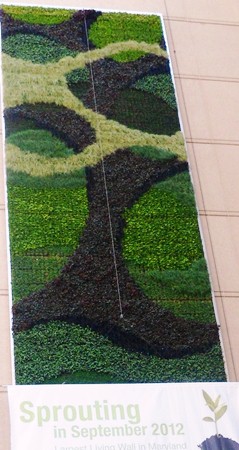
A Live Sculpture of Sprouts some 50 ft. off the ground in Baltimore, Maryland

No matter which side of the current political race you choose to support, I think we can all agree that this country is in a state of crisis. A growing number of people are out of work. The haves are dwindling in numbers at the same time that what they have is outdistancing the have-nots by leaps and bounds. We live in a global community that, if recent events are any indication, want our heads on a very pointy stick. Somebody should do something about it.

Riding in my car today, listening to old-time radio on my Sirius XM, I got to hear the perspective of a time when our country was in equally high crisis. It was a “Dagwood and Blondie” show from the early 40s. At the end of the program, the actors playing the leading roles made the usual war-time appeal to buy bonds. But, they also did something I had a hard time imagining our current stars of today even thinking to do, much less having the courage. The radio voices urged their audience to make the sacrifices now that would ensure that the government could pull itself out of its war-time financial hole once the action was finally over. “Don’t let us suffer as we did after the last war,” the voice said. The actors also told the audience not to buy items for prices other than what the government had set for them, not to buy items they didn’t really need, not to indulge when that indulgence would mean somebody else would suffer.

I couldn’t help but contrast this blunt, everybody-does-his-part approach to a weird commercial I saw recently involving actors of our day. In this modern commercial, we are shown back after back of famous people. Finally, they show their faces to say, “don’t turn your back on our military.” We’ve been involved in severe action for more than 10 years in dangerous conditions abroad. We are fighting an economic and social crisis at home, and these actors are just now coming out to say “don’t turn your back?” What’s more, their commercial gives no positive steps to do right now, no action points. The organization or cause the commercial is supposed to be promoting is even unclear.

I wonder what would happen if George Clooney had the courage to put himself in front of a camera and tell us to quit relying on the government to take care of us, to look to our neighbor to extend a helping hand and receive one, to remember that an honest day’s work, no matter what kind of work it is, is more valuable than a lifetime of handouts to one’s esteem and for the community at large?

During World War II, people planted victory gardens, canned everything they could, ate all leftovers. Housewives even saved used grease to donate for the purpose of making rubber. Ford assembly lines shot out tanks and war machinery at an even faster pace than they produced non-war-time cars. Even the children were not exempt from doing without so that the country as a whole might benefit.

Where is your victory garden today? You can’t fix the problems swirling around this country, but you can control you. All it takes is each one of us taking care of business, refusing to do what isn’t right, even if every one else around us is doing it, and being a helping hand whenever possible to start making a difference. With God, all things are possible. Let’s bring Him back into the fore again in this country, one Victory Garden at a time.

Posted in Christian Living, Living

Do You Really Want It?

20120923-185752.jpg Focus is a powerful word. Whatever we bring our minds to, we empower. The greater our ability to focus, the more we will accomplish.

In yoga class, you learn early on that proper focus is inherent to success. A mind busy thinking about to-do lists or wondering what’s for lunch is not a mind that will refresh and strengthen the body.

The key to meditation is being able to bring all the powers of your mind to the feelings in your hands so that eventually your mind and body are one, the only thought filling your mind being the mind-body experience you have just created.

The ability to block out the rest of our hectic life and essentially live in the moment, feeling only what our bodies and breaths tell us, is a powerful cornerstone for truly understanding what it means to “be still and know that He is God.”

How often do we ask God question after question without being silent long enough for Him to answer?

The skill of focus is not an easy one, especially not in a world in which we are bombarded by worldly messages. Billboards, smartphones with emails, internet access on-the-go, televisions constantly blaring–all of these things add up to potential side-trackers on our way to the narrow road.

When we have good focus, we can choose to let in only those messages that will positively affect our relationships with God, fellow Christians, and ourselves. But, when we let down our guard, as so often occurs, we allow negative messages to slip into our subconscious, convincing us that lies are truth–only women in tight clothes look pretty; how you look is who you are; winners only eat cornflakes for breakfast.

How do we increase our abilities to focus? We find the quiet places. Even if your quiet place and time is only five extra minutes lying still in your bed each morning before you arise to a new day, focusing on nothing except each breath you take in and out, you will soon discover that your mind will begin the day calmer.

If God speaks in whispers amidst the thunder of social media, tv media, gossip, work, and play that makes up most of a regular day, are we ever going to hear Him if we don’t first take the time to hone the one skill that we all possess?

To focus is to listen for God’s whisper. Where the mind goes, your heart will follow.

Posted in Christian Living, Living, Self-Help

Are You Too Old To Be “Schooled?”

20120813-184144.jpg Anyone who has ever been a teacher in a formal setting knows that you learn materials best by having to teach others, but you also know that you have plenty of things you can also learn from your students, as long as you are open to the idea.

But, anyone can benefit from the possibilities that occur when we are open to learning from others, no matter if we are supposed to be teaching those others or not. And those others can be young people half our age as well as our “elders,” can be people who make almost no money to those who make millions.

Case in point: I have been doing desktop publishing for our family health food store for almost 17 years, an outcropping of experience I started gaining when I was just in high school journalism classes. Lately, I have had to hand over some of my duties to a young woman who works for us. She is about to begin her junior year in college. I am almost 20 years out from my graduate degree. Sure, so far, I’ve had to edit her work as she puts together test ads for me, but they are fairly small changes that I can easily explain to her to improve upon the next time.

What I have learned so far is that it is very nice to have a second voice offering ideas about advertising slogans and perspectives. It is quite a bit quicker to edit an ad layout that is already quite strong than to have to come up with the entire ad to begin with. I also have been reminded that other people can come up with creative and intelligent ideas.

Today, I even learned that I could use a computer program I hadn’t even thought about in a while to create cropped pictures with traced transparencies that will be very useful for my advertising and marketing and website purposes. I was so happy to be able to say to my younger employee that we could learn from each other during this process! And the employee was excited too.

My point is that in order to learn from anyone, from a superior at work to a young person you might otherwise write off as naive or inexperienced, you have to be open to the possibilities and willing to see the world through an unbiased lens. Forget the attitude and especially the fear that keeps you from admitting that you still have things to learn, especially when you are dealing one-on-one with somebody. I think you will find that people will respect you more when you are honest about what you know and don’t know instead of putting on an act of bravado and never admitting that you still have something to learn.

God wants us to be always open to instruction. The Proverbs discuss the importance of discipline. The Old Testament is replete with reminders that God will humble us if we do not take care of our attitude ourselves. In the New Testament, Jesus reminds us that we must come to Him as little children, meaning with an attitude of full faith that includes admitting we don’t understand everything but are willing to believe anyway.

None of us are ever too old to be schooled. And since we never know exactly how God is working the things that happen in our lives to the good, don’t we all have every reason to be open to learning from anything and everything that happens to us? Even a two-year-old knows a few things that we have managed to forget as adults. Have you ever seen a better nap-taker?

Posted in Christian Living, Faith, Living

You Want To Know These Three Important Questions For Your Life

We can ALL be this relaxed. Read how.

I have been doing a much better job lately of living day-to-day.  This approach to life, realizing that what I really have is only this moment, taking to heart Jesus’ admonition to take care of this day because each day has enough trouble of its own, is really a great leap forward for a compulsive worrier such as myself.  It is a very freeing way to approach life when you don’t bog yourself down with the “what ifs” that plague the anxiety-ridden.

As God so often works, I happened to read a really great passage in C.S. Lewis’ Scewtape Letters this week that will help me live each moment in an even more Godly way.  After all, it’s easy to live-in-the-moment and fall into the trap of living for the moment, plunging yourself solely into the pleasures and challenges of this life instead of contemplating the next one.


What C.S. Lewis proposes is that each person has three questions to ask of herself before doing anything:

  1. Is it righteous?
  2. Is it prudent?
  3. Is it practical?

We need to be sure that we define these questions according to the Bible.  The first word, righteous, means “acting in accord with divine or moral law; free from guilt or sin” according to Webster’s Dictionary.  If we want the Bible’s definition, we need only turn to the Sermon on the Mount, starting in Matthew 5, to learn about this word from every angle.  Jesus simplified righteousness the most when He summed up the law with two edicts: loving God first and most and loving and treating everyone else as we ourselves want to be loved and treated.  So, when I ask myself, is this righteous, I know I have to begin my thinking in the realm of love that IS God.

Something that is prudent is “marked by wisdom or judiciousness” (Webster’s).  We know from the Proverbs that fear of God is the beginning of wisdom.  We also know that we can only gain wisdom of God through daily study of His word, daily time with Him in prayer, and concsious knowledge on our part that we really don’t know anything at all when compared with God’s wisdom.  So, is our action wise according to the dictates laid out by God, according to His goals for a Christian’s life?

Practical things are “manifested in action, not theoretical or ideal.”  They are “capable of being put to use or account/ useful” (Webster’s).  It can be so easy to get caught up in our own thoughts all the time, wondering or complaining about how things should be instead of taking care of how things are.  But, practical actions are more likely to point outward, to think of others instead of just the self.  It’s all very easy to say to ourselves that we love other people.  It is another thing altogether to serve food in a soup kitchen or volunteer for a community group or bake dinner for the older neighbor who lives next door.  Again, Jesus helped define what was practical during His ministry, often to the shock of the “more religious” Pharisees, who could not see the holiness of some of His actions because they could not see past their own rigidly-defined religion.  For example, they did not understand how unclean things like utensils used to eat on the outside do not make a person unclean on the inside.

It’s often been said to count to ten before speaking when you are angry.  I like this idea of taking time to ask myself three questions before I take an action or say something I may otherwise regret.  I especially love the way that God works for the good the things that happen in our lives.  Just as I am learning to live without worry, God gives me something positive to think about to make my “moment-living” even more productive from a Christian perspective.  Thank you, Jesus!

Posted in Christian Living, Faith, Living

Every Moment Blessings

Blooming Rose  This past Mother’s Day weekend, I got a real opportunity to stop and smell the roses.  Well, since I was on some acreage in Shep, Texas, (which is outside of Abilene, for those who don’t know) it was more like the opportunity to smell the cacti flowers and wildflowers I couldn’t identify.

Still, roses or Indian brush, the ability to be out in nature among bright blue skies, fluffly, white clouds overhead, only the sounds of our feet crunching in the dry grass and the insects buzzing, was a rare opportunity that I truly relished.  Even though the creek on the property where we were walking was still quite dry, it still offered tranquil moments as it gurgled.  With the family gathered around me, it was truly a wonderful day.

God’s blessings sneak up on us just like my lazy Sunday.  I didn’t really plan to get to walk around on land that once was the site of a Butterfield Stage route stop, viewing carvings in rock from the late 1800s where travelers literally left a mark on their ways further West.  Looking at dead trees lying crumpled in pieces, wild grasses re-claiming them, at fully-canopied trees reaching out over the water, casting shadows that promised a cool breeze away from the bright sun, my whole world was condensed into each, full breath.  For that moment, at least, all was peace.

How often am I too busy to take those full breaths in my day-to-day life?  And yet, God’s blessings are there for me to notice and enjoy every day–in the smile of a stranger, in the good news from the doctor, in the door being held open for me, in the call from a good friend.  Sometimes, those blessings are more like the ability to remain standing when life presents you with some devastating news or the near-miss in your car that keeps you out of an accident.

Regardless, God’s blessings come so hard and fast that we really should take time each day to stop and count them.  Some people do this through a thankfulness journal at the end of each day.  Others do it through prayer.  But what if we faced each day living every moment in full awareness of God’s current blessing?  Would we be cocooned like I felt on that homestead in Winters, regardless of the challenges of day-to-day living?  Think about what wonderful things we might accomplish for Him surrounded by such awareness.

This state of being is easier said than done, but anything worth doing takes great effort.  And, of course, we can be assured that God will help us in the doing as well.  Just another every moment blessing!