
Posted in Christian Living

On This Rock

PhotoFunia-river

When I was young, my Sunday school teacher explained that the Bible was such a great book, in part because it was too complicated for the most intelligent person to completely figure out and yet the simplest mind could understand its core messages.

By spending regular time in the Word, you discover that what you read can often be applied to whatever you are currently experiencing. Make Bible reading a part of your regular routine. For example, I read my Bible every day as I walk on my treadmill.

During the last week, my reading gave me several verses to help me cope with stress. They reminded me of God’s power and His intent to take care of me, no matter what bad happens to me in this world of evil.

When the psalmist says, “Make me hear sounds of joy and gladness; let the bones you crushed be happy again” (Psalm 51:8), I find someone who feels like I sometimes feel–beat down by the world’s cares but wanting to feel weightless again.

This feeling of reaching for the light is further emphasized in Psalm 51: “Give me back the joy of your salvation. Keep me strong by giving me a willing spirit (12).” I am reminded that I am supposed to have joy in this world because of my salvation through Christ, but that I need to have a can-do attitude that is willing to reach for peace when I feel most tumultuous.  If I choose to find joy in my salvation, God will help me rise above the challenges of day-to-day living.
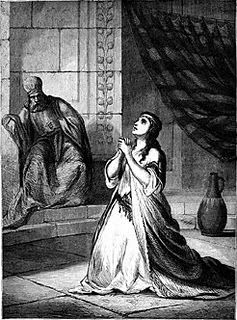
Hannah Praying for a Baby

Do you remember the story of Samuel? His mother, Hannah, was barren, ridiculed by her husband’s first wife because Hannah could not have children. In a culture where children were the measuring stick of success, Hannah was an abysmal failure. In the psalmist’s terms, her bones had indeed been crushed.

Hannah could have wallowed in despair. Instead, she poured her sorrow out before the One who could help her. She promised God to dedicate her child to His service if she ever had one. Shortly after Hannah’s heartfelt plea, God indeed blessed her with a son, Samuel, who later became a renowned leader of the Jewish people.

In thankfulness for her blessing, Hannah sings a song of praise, in which she says:

There is no one holy like the LORD. There is no God but you; there is no Rock like our God. (1 Samuel 2:2)

God had indeed served as Hannah’s rock. Her faith in Him helped her survive years of being barren and blessed her finally with children.

As a person with anxiety, I too must strive to make God my Rock, especially on my bad anxiety days.

How does God as your Rock look? To me, He is the boulder held fast in the midst of a raging river. The mist of roiling water might soak me eventually, but I will not drown. No matter how high the water rises, my Rock will always rise above it.

And rising higher still than the rapid water is the clear, blue sky that stands for the joy of my salvation, for the ultimate gift of a loving God that makes this life livable.

If you don’t already, make Bible reading one of your daily habits. Build upon the Rock of your salvation with the Word of God. You will always find something of use in your daily life there.

Posted in Christian Living, Faith

Verses I’m Thankful I’ve Read

20121125-152849.jpg
In Second Chronicles, Chapter 34, we are reminded in a not so subtle way how grateful we should be to have the Word of God so readily available to us. It is 622 B.C. During repairs to the temple, the priest Hilkiah finds the Book of the Law. Scholars apparently debate whether this book, likely Deuteronomy, had actually been lost or was created at this time. But one thing that cannot be debated is the king’s reaction to the discovery.

“Go and inquire of the LORD for me and for the remnant in Israel and Judah,” he orders after tearing his robes in dismay, “about what is written in this book that has been found. Great is the LORD’s anger that is poured out on us because our fathers have not kept the word of the LORD; they have not acted in accordance with all that is written in this book” (2 Chron 34:21).

After hearing from the prophetess Huldah, the king calls together all the people, “from the least to the greatest,” to read out loud the words of the lost book and renew the covenant his people should have with God. He removes the idols from the places of worship, and the chapter concludes by telling us that as long as he lived “they did not fail to follow the LORD, the God of their fathers” (2 Chron 34:33).

Isn’t it unimaginable that a people who had witnessed the power of God first hand, who had been fed by Him in the desert and led by Him as a pillar of fire, who had seen the Red Sea parted and the Egyptian first-born slaughtered about them, would ever come to a time where they had so loosed their attachment to that God they actually forgot some of His written edicts? They had lost His word so completely, that they were worshipping idols against His express instructions.

Yet, how often do we, who have an abundance of access to the Word of God, tend to lose it in our own way? How many of us can point to the exact portions of the Bible that back up why we believe what we believe? Do you know, for example, that many people’s concept of hell is more influenced by Dante, their picture of the Garden of Eden and the Fall drawn more by Milton than by the word of God? The influence is so woven into the fabric of our culture, that most of us don’t even realize it.

But those who study the Word and know it will be least likely to fall into the trap of believing something that is false or losing the Bible altogether.

I have a sort of unwritten promise to myself that I will one day compose an organized list of the verses in the Bible that I am glad I have read. These are words that let me know the meanings of grace and faith, define for me the qualities of a Christian, remind me that even a person with a heart like God’s can be fallible. They are the core defenses against those who would argue hatred in the name of God instead of the love He makes apparent. They are the keys to true belief that will keep me from straying as the “fathers who did not keep the word of the LORD.”

To have verses to be thankful for, we must first have read the verses of the Bible, and not just the verses we find pleasing or in accordance with our own preconceptions. To pick and choose without looking at the whole is a dangerous game indeed. More than one despot has validated himself by the word of God cut up in such a fashion.

I am thankful this Thanksgiving weekend to have the word of God to study on a daily basis and in a variety of contexts. I am prayerful that I will not lose those words, nor lead others to forget. What verses are you glad you have read? What verses will you add to your list tomorrow?